1. How concerned are you by the hardening conflict between US and Chinese imperialism in East Asia, and globally? What, in your view, are the roots of this conflict?
Now the war in Ukraine has kept on going for about two and a half years, as a proxy war between imperialist alliances of the US-led NATO vs. China-backed Russia. Israel has tried to provoke another war in the Middle East over the genocide in Gaza with unconditional support from the US. Military tension around both Taiwan and the Korean peninsula has reached the highest point in several decades. The economic war between the West and China in the name of decoupling or derisking has been more and more intensifying. All of these indicate that we are now living in a very volatile world, which is supposed to be increasingly covered with blatant imperialist conflicts and (proxy or even direct) wars.
This epoch is the direct result of the capitalist development in the previous epoch, characterized by neo-liberalism, globalization, and financialization. Especially, globalization moved the production base from the West to the emerging countries and changed the balance between capitalist states. It relatively weakened the power of the West and strengthened the emerging countries. In particular, China became the second imperialist power, surpassing many Western powers through the global financial crisis in 2008 and its aftermath.
Another important factor we need to understand is the increasing difficulty of global capital getting enough profits. Actually, all the core measures of the previous epoch, that is, neoliberalism, globalization, and financialization, were to generate more profits for the capital. And for some time, those measures were working well. However, neo-liberalism reached the point that there was effectively no more room to loot workers’ rights and conditions without fascism. Globalization reached the point that the growth of emerging countries threatened the dominance of the world by the established imperialist powers. Financialization reached the point that it almost destroyed the whole capitalist system itself in the form of a global financial crisis.
It is quite natural that the overall rate of profit by capital should be getting lower due to the higher organic composition of capital as the technology and productive forces develop in terms of long-term trends. However, preserving enough rate of profit for more profits is the most important drive for capitalism. So now that the previous measures are powerless, capitalism has been developing more drastic measures. Instead of neo-liberal tendencies, far-right forces are now getting bigger and bigger influences in more and more countries, preparing for much harsher looting of workers’ rights and conditions. Despite the obvious possibility of destroying the whole capitalist system due to the explosion of fictitious capital one day, capitalism is relying more and more on financial speculation and expropriation for part of its profits.
The global trend toward more imperialist conflicts and wars, with the hegemonic confrontation between the US and China at its peak, is an integral part of this whole trend of capitalism. The efforts of each imperialist power to make a new way for their own capital through the favorable change of the geopolitical balance represent the desire of the whole capitalism to overcome the difficulties of capital getting enough profits. One more thing we need to consider about the characteristics of the imperialist confrontation in this epoch is that no side (between the US and China) is in its ascending period and has the power to secure a decent life and brighter future for the workers and people, even in their own countries. It means no side has real “hegemonic” power over its allies, and the overall development to come will likely be featured by some kind of desperation for survival, rather than some kind of hope for the future.
2. Recently, Putin made his first visit to North Korea in more than 20 years. It seems the North Korean regime is becoming an integral member of the China-Russia bloc that is opposing US imperialism and its allies. How do you evaluate the actions and motives of the North Korean regime, and how big a change is this?
After the USSR’s collapse and China’s Reform and Opening Up in the early 1990s, North Korea was seriously isolated on the international stage. The rulers of the country developed nuclear armament as a bargaining chip for negotiations with the US to escape from its isolation. Both China and Russia, as permanent members of the UN Security Council, agreed to and participated in the sanctions against North Korea, by the UNSC with the lead of the US, for its nuclear experiments or launching ballistic missiles until North Korea declared the completion of its nuclear armament in 2017.
After exchanging nuclear threats for some time, US President Donald Trump and North Korean leader Kim Jong-un held a so-called “peace talk” two and a half times in 2018-19, but it ended with no result. The North Korean leader failed to make a good relationship with the US, its longtime goal, even though it completed its nuclear armament, but he gained an important result on the other side. During that period, Kim Jong-un managed to meet Xi Jinping five times and Vladimir Putin one time, which was previously impossible under its severe international isolation. At that time, the summits were seen as countermeasures of China and Russia against the possible agreement between the US and North Korea. But it was proved to be more than that.
In 2020, China and Russia began to reject further sanctions by the UNSC against North Korea for the violation of UN resolutions banning ballistic missile launches, making it the new normal in the regional situation around the Korean peninsula. It was an important signal that China and Russia began to establish their own pole in their mutual collaborations against the hegemonic power of the US, even before the breakout of the war in Ukraine in 2022.
The war in Ukraine marked the beginning of the sharp confrontation between the US-led Western alliance and the China-Russia alliance. And as we have seen, the confrontation has continuously developed sharper and sharper for two and a half years. For North Korea, this new international situation meant a decisive opportunity to escape from its international isolation. From the beginning, North Korea clearly chose to support Russia, instead of a possible vague or neutral position. North Korea seems to have sent a considerable amount of conventional weapons and ammunition to Russia to support its war operations, just like South Korea has sent the largest amount of ammunition to Ukraine among Western countries through third-party countries.
The summit between Vladimir Putin and Kim Jong-un in September 2023 and June 2024 showed the world this development openly, especially North Korea’s ardent participation in the China-Russia alliance. Feeling escaping from international isolation, the North Korean leader has tried to show his confidence to the world since the second half of 2023. Among them, he declared that North Korea would no longer pursue the reunification of the Korean peninsula at the end of 2023, redefining South Korea as an enemy in the war, not the same nation.
If someone considered the North Korean regime as a progressive one, its strong support for Russia’s blatant imperialist invasion and relegating the cause of reunification to just tactical rhetoric would be very difficult to understand. But if you saw the real nature of the regime to exploit and oppress the workers and people, and its eagerness to side with any international powers only to secure the regime, you could easily understand that this development is the natural result of the current international situation, even though it apparently looks like a big change.
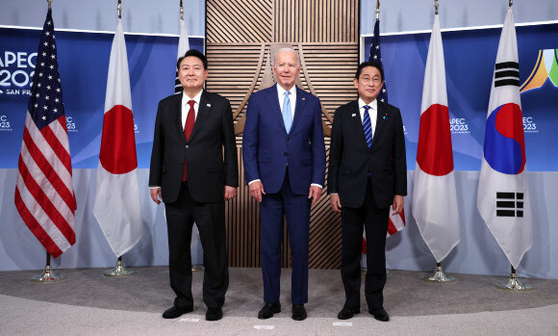
3. Japanese imperialism is rapidly expanding its military power and ambitions as part of the US-led bloc. Also, the South Korean government of Yoon Suk Yeol is increasing militarization and has moved into an ever-closer military/geopolitical embrace of Japan and the US, against China. Could you explain why and how this has happened? And also, did it begin only since Yoon came to power, or does this process go further back?
We need to see two things separately. The first thing is that South Korea is actively supporting and participating in the US-led multinational alliance against the China-Russia alliance in the geopolitical/military area. The second thing is that, in doing so, South Korea is actively collaborating with Japan. As for the first thing, the Yoon government’s policy is not new, even though it is more intense. In the aspect of the second thing, this government’s policy is relatively new and reflects not only the intensification of regional tension in East Asia but also this government’s ever-strong pro-Japanese character.
In September 2015, the former right-wing president of South Korea, Park Geun-hye, visited China and attended its Victory-over-Japan Day ceremony, standing with Xi and Putin. At that time, the South Korean government tried to keep a good geopolitical relationship with China to maintain its economic relationship with China as its largest trading partner, even though the US had already been implementing its Pivot to Asia policy against China since 2011. But, after the US inflicted some kind of very strong pressure, the details of which still remain unknown to the public, the South Korean government changed its policy rapidly. In July 2016, the Park government agreed to the installation of the Terminal High Altitude Area Defense (THAAD) system, a part of the global Missile Defense system of the US, in South Korea, aiming at China and North Korea.
The THAAD deployment policy was succeeded by the next center-right Moon Jae-in government, against which the Chinese government retaliated through various economic sanctions, a starting point of the reduction of economic correlation between the two countries. The Moon government tried to shorten the time for retrieving its Wartime Operational Control from the US, as a reflection of the desire for more independent sovereignty that some part of the Korean ruling class and petty-bourgeoisie had. But his main policy for that was the rapid strengthening of its military power under the US leadership. Such rapid military strengthening and joint military exercises with the US were continued under the Moon government, even during the so-called Korean Peace Process period in 2018-19. And they were some of the important reasons that made the three inter-Korean summits end in failure.
When this Yoon government was inaugurated just two months after the outbreak of the war in Ukraine, the global geopolitical terrain was sharply changing with the impact of the war. Japan announced its further militarization with the target to make military spending two percent of GDP in five years. The US, which revived NATO against Russia in Europe, has been trying to build a NATO-like military alliance in the Indo-Pacific region. Building the US-Japan-South Korea alliance in North-east Asia against the China-Russia alliance, as well as North Korea, is one of the core parts of that strategy. The Yoon government has faithfully followed the US imperialism’s strategy, and in this aspect, even if this government had been a center-right one, there would have been no substantial difference.
However, the assumed center-right government would have been more reluctant than this government to develop mutual relationships with Japan, especially when the Japanese government had no intention to seriously apologize and be responsible for its imperialist war crimes in the past. But the center-right government also wouldn’t have been free from the strong pressure from the US for the collaboration between Japan and South Korea.
4. How has the attitude of workers and young people in South Korea shifted based on these developments? Is there greater fear of war, even nuclear war? Or is there a pro-war mood? What changes have there been in attitudes towards Japanese militarism and towards Korean unification?
According to the surveys by the East Asia Institute (EAI) in South Korea, the proportion of Korean people who consider China a military threat changed from 10.1 percent in 2015 to 36.2 percent in 2016, and to 57.9 percent in 2023. During the same period, the proportion of Korean people who consider North Korea a military threat changed from 71.7 percent in 2015 to 83.4 percent in 2016, and to 89.7 percent in 2023. The proportion of Korean people who consider Japan a military threat changed from 15.1 percent in 2015 to 37.7 percent in 2016, and to 28.9 percent in 2023.
However, the proportion of Japanese people who consider China a military threat showed less change from 64.3 percent in 2015 to 71.5 percent in 2016, and to 68.0 percent in 2023. The proportion of Japanese people who consider North Korea a military threat also showed less change from 71.6 percent in 2015 to 79.1 percent in 2016, to 80.0 percent in 2023. Interestingly, the proportion of Japanese people who consider Russia a military threat showed big changes twice, from 19.0 percent in 2013 to 29.0 percent in 2014, and from 30.7 percent in 2020 to 60.4 percent in 2023.
According to the surveys by the Korean Institute for National Unification, the proportion of Korean people who have a fear of nuclear war due to North Korea’s nuclear armament maintained around 40 percent from 2019 to 2021. The proportion who think North Korea’s nuclear armament affects their everyday life remained less than 20 percent during that period. Such figures might be similar in 2024. Those figures ironically show the low interest and fatigue of Korean people in the chronicled high military crisis around the Korean peninsula. There is no survey about the pro-war mood because almost all Korean people don’t want another war on the peninsula, which they believe would be a total destruction of their lives and civilization within a very short time.
According to the surveys by the EAI, the proportion of Korean people who are for vs. who are against the intervention of the Self-Defense Force of Japan into the Korean peninsula in case of emergency changed from 46 percent vs. 53 percent in 2014 to 28 percent vs. 60 percent in 2021. The figures in 2024 would be similar to those in 2021, because the Yoon government’s pro-Japanese policy has been considerably unpopular.
Meanwhile, according to the surveys by the Institute for Peace and Unification Studies at Seoul National University, the proportion of Korean people who consider the unification of the Korean peninsula necessary vs. unnecessary changed from 63.8 percent vs. 15.1 percent in 2007 to 53.6 percent vs. 20.0 percent in 2019, and to 43.8 percent vs. 29.8 percent in 2023. Especially among young people who are 19 to 29 years old, the negative opinion was expressed more strongly, from 41.1 percent vs. 25.3 percent in 2018 to 28.2 percent vs. 41.2 percent in 2023. The proportion of Korean people who consider North Korea a partner vs. an enemy changed from 56.6 percent vs. 6.6 percent in 2007 to 54.0 percent vs. 10.8 percent in 2019, and to 37.7 percent vs. 18.6 percent in 2023.
5. What is the current state of the workers’ movement in South Korea, which has one of the highest rates of trade union organization in the entire region?
The unionization rate in South Korea changed from 10.3% in 2016 to 13.1% in 2022. The total number of union members was about 2.7 million in 2022. Among them, the number of members in the Korean Confederation of Trade Unions (KCTU), the national center of real independent unions (despite considerable bureaucratization), was about 1.1 million, which meant a 5.3% unionization rate. But the KCTU has much more social power than the number of members because it covers many strategic sectors in Korean capitalism, both public and private, such as automobile, shipbuilding, chemistry, railway, subway, truck transportation, construction, healthcare, power plant, mass media, teachers and various school workers, civil servants, etc.
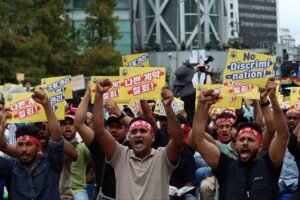
The great strike wave in 1987 was the starting point of the democratic (in other words, independent) trade union movement. From July to September, more than 3,300 strikes with 1.2 million participants erupted all over the country like a volcano. It was just after the virtual victory of the Democracy protests in the streets against the military dictatorship in June. Almost all strikes were illegal and very combative to the degree that occupying the workplace was the common base. They were unauthorized and wildcat strikes against the Federation of Korean Trade Unions (FKTU), the national center of yellow unions. The strike wave resulted in about 1,000 democratic unions at the workplace level. They tried to unite with each other based on region and industry against the military and civil regimes’ harsh repression. Their efforts ended up in building the KCTU in 1995.
The month-long general strike by the KCTU in 1996-97 showed the potential of the Korean working class. The general strike was against the neo-liberal labor reform for work flexibilization, especially the introduction of the legal lay-off system and the worker dispatch system. The general strike managed to postpone the introduction of two measures, but a year later, when the Asian Economic Crisis came, the two measures were finally introduced. Many regular workers faced mass lay-offs and their positions were replaced by various forms of irregular workers, such as temporary workers, sub-contracted workers, so-called self-employed workers, etc.
Against the mass lay-offs, democratic unions, which were basically composed of regular workers at that time, managed to show their powerful ability to resist through militant strikes, even though they failed to revoke the mass lay-offs themselves. So the capitalists chose to focus on intensifying the exploitation of irregular workers, trying to maintain good relationships with regular workers and their unions. It resulted in big disparities between regular workers and irregular workers in their wages and working conditions. For example, in 2023, irregular workers received only 54 percent of the wages of regular workers on average.
These disparities have affected the whole terrain of class struggle. Most irregular workers consider these disparities more serious than the much wider gap between the capitalists and the working class because regular workers are closer to them. Taking advantage of this feeling among irregular workers, the bourgeois parties have successfully isolated the democratic trade union movement, the most important social force not only for workers’ rights but also for overall social progress in South Korea. The fact that the proportion of irregular workers in the KCTU membership increased from only 2 percent in the early 2000s to about 30 percent these days shows a certain amount of progress to overcome this problem, but there is still a long way to go.
6. Can you explain the balance of forces within the workers’ movement society, between pro-North Korea political groupings and those that adopt a broadly pro-Western or anti-North Korea/anti-China stance? What is the main base of support of these forces, respectively?
Due to the aftermath of the Korean War in 1950-53, during which about 3 million people were killed or disappeared in the Korean peninsula, all kinds of revolutionary or leftist movements were eradicated in South Korea. Since then, the political and social terrain of South Korea has largely been biased to the right and pro-US, in other words, anti-North Korea and anti-communism.
However, after the Gwangju Uprising in 1980, a small movement society with independent perspectives from the main society was created in South Korea. Initially, the movement society was largely comprised of the university student movement. But nowadays, the movement society is mainly composed of the workers’ movement (with the KCTU at its core) and various progressive social movements. The university student movement and the farmers’ movement are much smaller than in previous days. The movement society has been based on some common sense, such as social justice and equality for the rights of workers and the oppressed, democracy against military dictatorship or authoritarian regimes, etc. Anti-US imperialism and unification of the Korean peninsula can also be considered as part of the common sense of the movement society.
The National Liberation (NL) tendency has been the main current of the movement society, but it has continuously harmed the independent perspectives and developments of the movement society by its pursuit of collaboration with the center-right bourgeois Democratic Party and its pro-North Korea policies. The second largest tendency has been various kinds of reformists. And there has been a small portion of socialists with revolutionary working-class perspectives.
Nowadays, the NL tendency still has the largest influence on the movement society. However, its influence in the mass movement has largely been based on the cause of unification, rather than anti-US imperialism or even pro-North Korean perspectives. However, after the North Korean leader, Kim Jong-un, announced North Korea would no longer pursue unification in late 2023, the NL tendency had to change its political direction from unification to national independence against US imperialism and peace against possible war. The problem is that they have no criticism of the China-Russia imperialist alliance and North Korea’s participation in it.
Among reformists, a kind of pro-Western current has recently been growing. They argue that the so-called rule-based international order (in other words, Western order) is better or more progressive than the ‘rule-destroying’ China-Russia camp. Their argument is not new but a part of a common base in the main South Korean society, still largely biased to the right and pro-US. But, within the movement society, their argument still doesn’t have meaningful support, even though relatively stronger base among reformists, because the movement society is still basically based on anti-US imperialism.