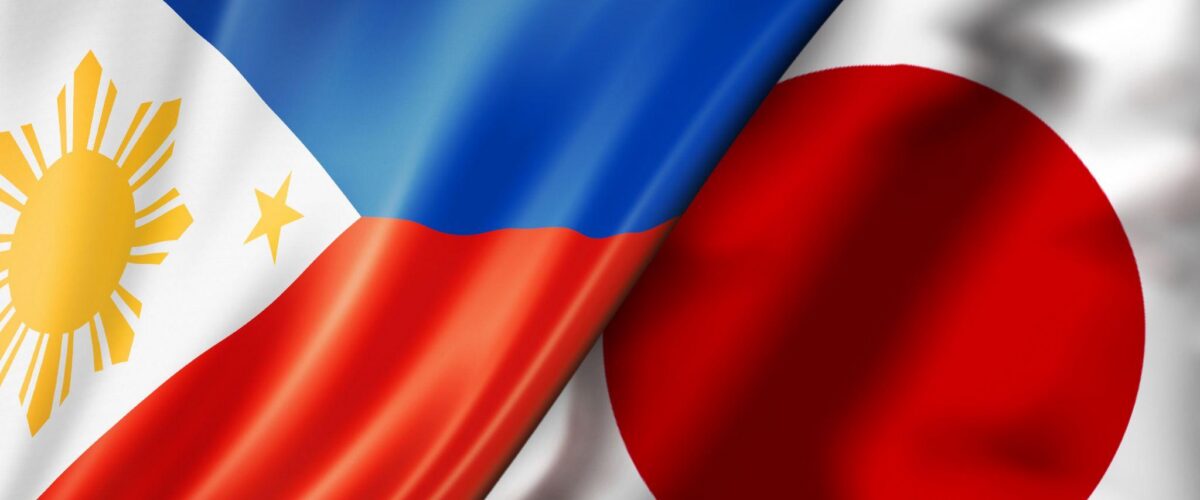
Japan and the Philippines are deepening defence and maritime cooperation, one step further in the increased japanese militarist stance.
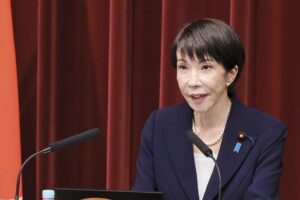
Sanae Takaichi, Japan’s prime minister, is engaged in a campaign to increase the military budget and to push for constitutional changes that would allow larger military expenditures, in light of the risks posed by the expansionist aggressiveness of the Chinese Communist Party bureaucracy.
That has broad implications that analysts say reach beyond the South China Sea.
Following Philippine President Ferdinand Marcos Jnr’s state visit to Tokyo last week, the two sides agreed to launch formal talks on military intelligence sharing and maritime boundary delimitation, while elevating ties to a comprehensive strategic partnership.
Beijing responded, denouncing the boundary talks as “illegal and invalid” and dispatching coastguard vessels on Monday for law enforcement patrols east of Taiwan.
Also on Monday, Manila and Hanoi elevated their ties to an enhanced strategic partnership and renewed their memorandum of agreement on defence cooperation, with Marcos saying it would bolster their joint capabilities in maritime security.
At a joint news conference in Manila with Vietnamese leader To Lam, Marcos declared that “as fellow claimant states, we reaffirm that maintaining peace, stability and the freedom of navigation and overflight in the South China Sea remains non-negotiable”.
These developments were linking Beijing’s most sensitive maritime concerns – from the South and East China seas to the Taiwan Strait – into a more integrated security front.
This is connected to the United States’ ambitions in the Asia-Pacific. Despite Trump’s caution not to provoke China, Washington has been developing closer relations with the Takaichi government and testing the limits of Beijing’s patience. The administration has facilitated major Japanese investments in the U.S. and signed joint agreements to deter aggression and bolster deterrence in the Indo-Pacific.
Lucio Blanco Pitlo III, a research fellow at the Manila-based Asia Pacific Pathways to Progress Foundation, said closer Japan-Philippines military and logistical cooperation would complicate Beijing’s planning in a Taiwan crisis.
While intelligence sharing and evacuation planning might already be under way, Pitlo said Beijing’s greater worry was its two coastal neighbours “linking the maritime flashpoints into one unified theatre”.
In Japan, there is an overall debate about the constraints on the military budget. These constitutional constraints placed on Japan’s military were highlighted in March, when Takaichi cited article 9 when she turned down a request – reportedly with reluctance – by Donald Trump to send the maritime self-defence forces to the strait of Hormuz.
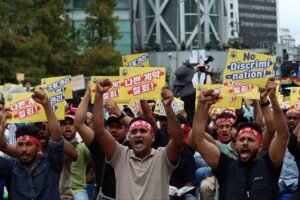
Protests are rising, too. On constitutional memorial day, an estimated 50,000 people gathered at a park in Tokyo in support of the restrictions against imperialist military spending, whose wording has remained unchanged since it went into effect on 3 May 1947.
Japanese imperialism is attempting to push forward a policy of rearmament, in line with militarist trends in Europe and the United States. This is a reactionary policy that will bring no benefit to the working and poor people of East Asia. The Chinese capitalist government is part of this militarist trend, which must also be rejected. It is of vital importance that Asian youth take the anti-militarist struggle into their own hands, inspired by the youth movement in Germany.