Japan’s prime minister, Sanae Takaichi, has called for “advanced discussions” on revising the pacifist constitution, as large demonstrations were held nationwide to oppose any changes to the country’s supreme law.
Speaking during an official visit to Vietnam, Takaichi said the constitution, which was written by US occupation forces after the second world war, “should periodically be updated to reflect the demands of the times”.
Takaichi and others on the conservative wing of the ruling Liberal Democratic party have long called for change, saying the current document restricts Japan’s ability to respond to growing security threats from North Korea and China.
In a poll published at the weekend by the conservative Yomiuri Shimbun newspaper, 57% of respondents were in favour of revision, while a survey by the liberal Asahi Shimbun put support for reform at 47%.
The constitutional constraints placed on Japan’s military were highlighted in March, when Takaichi cited article 9 when she turned down a request – reportedly with reluctance – by Donald Trump to send the maritime self-defence forces to the strait of Hormuz.
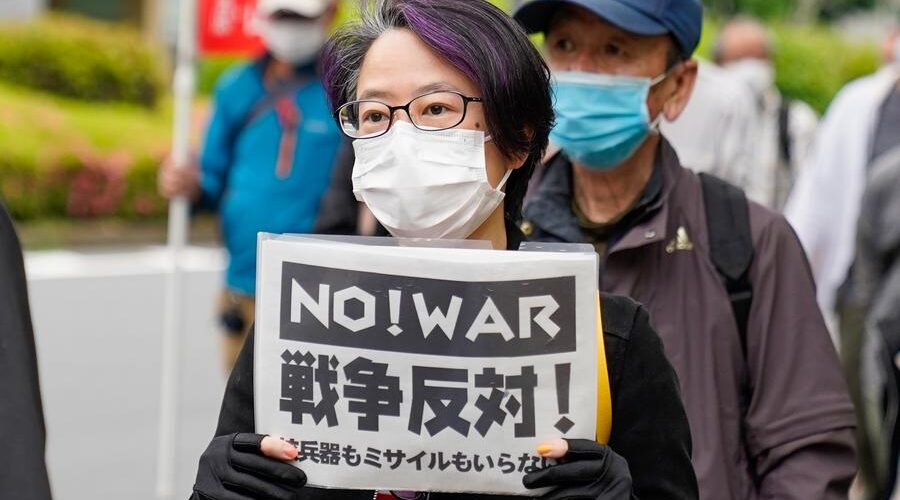
On Sunday – constitutional memorial day – an estimated 50,000 people gathered at a park in Tokyo in support of the document, whose wording has remained unchanged since it went into effect on 3 May 1947.
Protesters holding anti-war placards said article 9 had succeeded in keeping Japan out of ill-advised US-wars, including Iran.
“Under Takaichi, Japan is following America like a dog follows its owner,” said Hiroko Maekawa, a councillor for a Tokyo ward. “The LDP wants to turn the self-defence forces into a traditional military, because they know the constitution, as it is, prevents them from doing that.”
Japanese imperialism is attempting to push forward a policy of rearmament, in line with militarist trends in Europe and the United States. This is a reactionary policy that will bring no benefit to the working and poor people of East Asia. The Chinese government is part of this militarist trend, which must also be rejected. It is of vital importance that Asian youth take the anti-militarist struggle into their own hands, inspired by the youth movement in Germany.