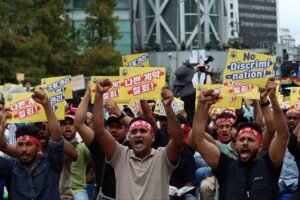
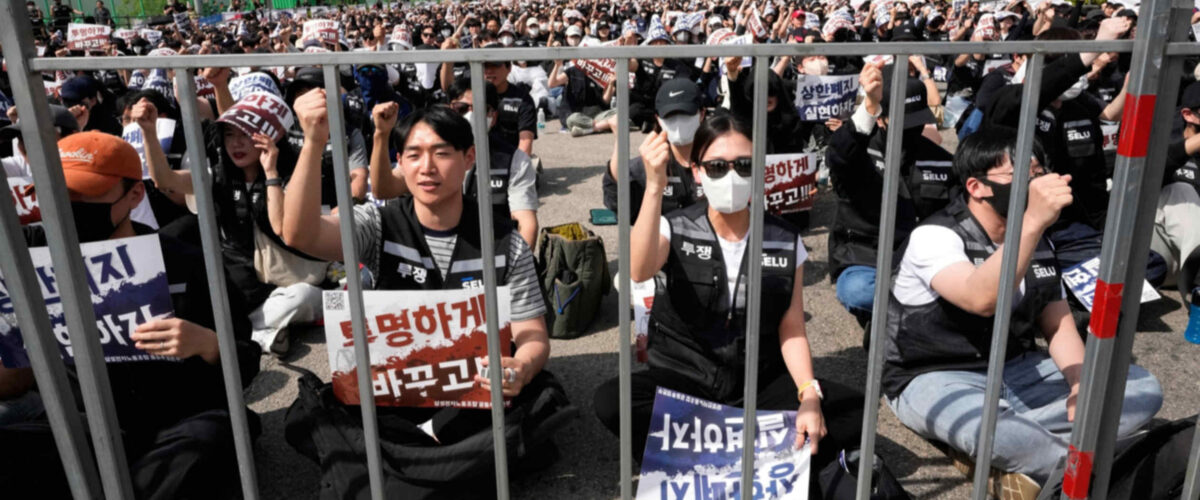
The Samsung Electronics Labor Unions’ Joint Struggle Headquarters—comprising the SELU(Samsung Electronics Labor Union, which is Samsung Group United Union’s Samsung Electronics Branch) and the NSEU(National Samsung Electronics Union)—reached a tentative agreement with management on May 20, thereby postponing the strike scheduled to begin on the 21st. The union will hold a membership vote on the tentative agreement from the 22nd to the 27th. The Samsung Electronics unions’ recent demands for performance bonuses and push for a strike have sparked significant social controversy.
The semiconductor industry’s boom driven by exploding demand for artificial intelligence and the Samsung Electronics unions’ performance bonus demands
The Samsung Electronics unions’ core demands were all focused on performance bonuses, including making the performance bonus system more transparent, abolishing the performance bonus cap, and paying a performance bonus equivalent to 15% of operating profit. Samsung Electronics employees are among the highest-paid workers in Korea, with the average annual salary for 2025 reported to be around $70,000. In addition to this, employees have traditionally received a separate performance bonus called the OPI (Overall Performance Incentive) at the beginning of each year. This bonus, which can amount to up to 50% of an individual’s annual salary, is paid if the performance of their respective business unit exceeds the target set for the previous year. However, there was significant dissatisfaction among workers regarding the fact that the specific criteria and calculation formula were not disclosed, and that the cap was set at a maximum of 50% of individual annual salary.
Amid this situation, the rapid growth of the artificial intelligence (AI) industry has led to an explosive increase in demand for HBM (High Bandwidth Memory) and DRAM (Dynamic Random Access Memory), which are essential for AI servers. Consequently, Samsung Electronics and SK Hynix—the two South Korean companies holding the highest market share in this sector globally—have experienced an unprecedented boom.1As of the fourth quarter of 2025, SK Hynix held a 57% share (ranking first) and Samsung Electronics held a 22% share (ranking second) in the global HBM market, while in the global DRAM market, Samsung Electronics held a 36% share (ranking first) and SK Hynix held a 32% share (ranking second). Samsung Electronics’ operating profit for the first quarter of 2026 (January–March) reached $37.8 billion, and its operating profit for 2026 is expected to exceed $200 billion. Considering that Samsung Electronics’ operating profits were $24.1 billion in 2024 and $30.5 billion in 2025, this gives a sense of just how dramatically operating profits are surging in 2026.
Meanwhile, SK Hynix’s first-quarter operating profit also surged to $25.4 billion, and its total operating profit for 2026 is expected to approach $200 billion. However, during labor-management wage negotiations in September 2025, SK Hynix agreed to pay 10% of operating profit as profit-sharing (PS) for the next 10 years and to abolish the individual performance bonus cap of 1,000% of base salary.2The most important reason SK Hynix backed down was that, while the workers did not go so far as to strike, they demonstrated their strength by rallying in large numbers. On August 14, 2025, more than 10,000 SK Hynix workers held a rally to voice their anger and demands, leaving the company with no choice but to take notice. In early 2026, SK Hynix distributed PS bonuses based on its 2025 operating profit of $33 billion; the average payout per employee is reported to have been approximately $100,000. If operating profit in 2026 approaches $200 billion as expected, the PS bonuses to be paid in early 2027 are projected to exceed an average of $500,000 per person. In contrast, Samsung Electronics’ performance bonuses averaged about $30,000 per person in early 2026, and if the bonus system remained unchanged, they were expected to remain at a similar level in early 2027.
While both Samsung Electronics and SK Hynix are experiencing unprecedented prosperity, the fact that Samsung Electronics employees could not receive performance bonuses as substantial as those at SK Hynix greatly frustrated them. Although the NSEU—which had maintained a cooperative relationship with the KCTU(Korean Confederation of Trade Unions)—was the largest union at Samsung Electronics, it was facing an organizational crisis due to the 2024 strike failing to yield significant results and issues regarding undemocratic organizational management coming to light. In this context, when the SELU began advocating for “fair distribution strictly based on performance” immediately after the resolution of the SK Hynix labor-management negotiations in September 2025, its membership grew from 6,500 to 73,000 by April 2026, eventually becoming a union representing a majority of Samsung Electronics’ regular employees, which led the current negotiations and the push for a strike.
Samsung Electronics workers’ exercise of their right to strike is justified
When the Samsung Electronics union announced its plan to launch a full-scale strike starting May 21 after raising demands for performance-based bonuses, the capitalist class launched a massive offensive. Samsung Electronics filed a petition with the court requesting an injunction to prohibit the union’s industrial action, arguing that “operating profits inherently belong to shareholders and the company,” thereby completely denying the workers’ efforts and contributions. Most media outlets, acting as mouthpieces for the capitalist class, attacked Samsung Electronics workers day after day, claiming that “if the workers’ demands are accepted, the competitiveness of the semiconductor industry will weaken and the overall economy will suffer a major blow.” They also argued that “Samsung Electronics’ massive operating profits are the result of the company’s proactive investments in developing cutting-edge technology and building manufacturing capabilities, and therefore workers have no right to claim a share of those profits.”
The government also pressured Samsung Electronics workers. President Lee Jae-myung personally stepped forward to attack them, stating that “the excessive and unreasonable demands of some workers are harming other workers.” As the strike loomed, the Prime Minister threatened on the 17th, saying, “If the Samsung Electronics strike becomes a reality, we will invoke Emergency Adjustment.”3Introduced by Park Chung-hee’s military regime in 1963 and invoked four times since then, the Emergency Adjustment grants the government the authority to forcibly suspend strikes and conduct arbitration on its own initiative. The next day, the President spoke out again, pressuring Samsung Electronics workers by stating, “Corporate management rights must be respected just as much as labor rights.” This was an extremely hypocritical argument, attempting to suppress workers’ right to strike in a society where corporate management rights dominate 365 days a year. By claiming that “while citizens’ fundamental rights are guaranteed, they may be restricted for the public welfare,” the President also disguised the interests and management rights of the capitalists as public welfare. On the same day, the court also joined in trampling on the right to strike, ruling that “the union must comply with its obligations regarding staffing levels and operating hours at the same level as usual even during industrial action.”
However, Samsung Electronics’ massive profits are social wealth created by the collective labor of the working class. Workers have the right to have the value of the blood and sweat they have shed over the years recognized.
For a very long time, Samsung Electronics has crushed workers’ resistance through its “union-free management” policy. Under the brutal dictatorship of capital, countless workers have been poisoned by all manner of hazardous substances, contracting leukemia and various rare cancers. They have suffered—and continue to suffer—enormous physical and mental anguish from night and shift work that destroys their circadian rhythms, regardless of weekends or day and night, as well as from high-intensity repetitive tasks. Mental health issues among Samsung Electronics workers are also at a very serious level. According to a health survey released in March 2024 by the group “Guardians of Semiconductor Workers’ Health and Human Rights,” the rate of sleep disorders among Samsung Electronics workers was 3.7 times higher than that of general wage workers, and symptoms of depression were 2.5 times higher. Suicidal thoughts were reported to be seven times higher, and suicide attempts ten times higher. Samsung Electronics’ performance has been achieved through the efforts and sacrifices of these workers.
Therefore, even though operating profits are astronomical, the workers’ demand to pay 15% of operating profits as performance bonuses is by no means excessive. This is also true because, if the workers do not fight back, management will take the lion’s share of the operating profits. In early 2024, Samsung Electronics did not pay performance bonuses to workers, citing the semiconductor (DS) division’s loss the previous year, yet awarded management a total of $134 million in company stock as performance bonuses. Samsung Electronics Chairman Lee Jae-yong received a total of $293 million in dividends in 2025 alone.
Weaknesses and Limitations of the Samsung Electronics Union’s Demands and Struggle
With a strike looming, the Samsung Electronics union reached a tentative agreement with the company late on the 20th. Management and labor agreed to introduce a special performance bonus for the DS (Device Solutions) division—which produces semiconductors—separate from the OPI performance bonus, funded by 10.5% of the division’s business performance, for a period of 10 years. It was decided that 40% of the special performance bonus fund would be allocated to the DS division as a whole, while 60% would be distributed to each business unit under the DS division—including Memory, System LSI (Large-Scale Integration), and Foundry—in proportion to their respective performance. The special performance bonuses will all be paid in Samsung Electronics stock.
According to this agreement, workers in the Memory business unit within the DS division are expected to receive an average of approximately $400,000 in special performance bonuses in early 2027, while workers in the System LSI and Foundry business units within the DS division are expected to receive an average of approximately $130,000. In contrast, workers in the DX (Device eXperience) division, which produces smartphones, TVs, and refrigerators, are said to receive approximately $4,000.
The outcome of the tentative agreement starkly exposed the weaknesses and limitations inherent in the demands and struggles of the Samsung Electronics labor unions. Samsung Electronics’ massive operating profits are the result of the collective social labor of not only Samsung Electronics’ regular employees but also all workers worldwide included in the value chain. However, the Samsung Electronics labor union demanded performance bonuses exclusively for Samsung Electronics’ regular employees.
Approximately 125,000 regular employees are working at Samsung Electronics’ production facilities in South Korea, including those in Pyeongtaek, Hwaseong, Giheung, and Onyang. There are also about 36,000 in-house subcontracted workers from roughly 150 companies working within Samsung Electronics’ production facilities, and approximately 370,000 workers from about 1,000 first-tier suppliers who directly supply parts to Samsung Electronics. If the goal was to demand special performance bonuses from Samsung Electronics, the campaign should have included at least this many workers. Had the union organized and united approximately 530,000 workers—encompassing regular employees, in-house subcontracted workers, and workers from first-tier suppliers—under the banner of equal performance bonus payments, it would have resulted in a breakthrough in the unity of the working class.
However, the Samsung Electronics unions did not take that path toward class unity.
It was not merely a problem of the leadership. There were no voices from the rank-and-file calling for class unity either. Although Samsung Electronics’ regular employees earn more than double the average wage of all workers in Korea, they were fixated solely on securing performance bonuses amounting to several times their base pay, failing to develop the working-class perspective that they must advance together with workers in far more precarious situations than their own.
The Samsung Electronics unions failed to maintain even unity among regular employees. From the very beginning of negotiations, the union leadership accepted the company’s position that performance bonuses would be paid only to the DS division—which generated significant profits—while effectively excluding the DX division, which had poor sales performance. During the negotiations, the union leadership sought to minimize disparities between business units within the DS division—where the majority of members are concentrated—but the outcome ultimately aligned with the company’s intention to maximize performance-based pay gaps between units within the DS division. The Samsung Electronics unions’ demands and struggles, which were not grounded in working-class solidarity, resulted in a failure to maintain even unity among regular employees.
The performance-based bonus system inherently contains a critical flaw: it incentivizes workers to voluntarily engage in excessive labor to boost the company’s performance. When performance bonuses vary drastically based on departmental performance, as seen in the outcome of this negotiation, such an incentive effect is further amplified. The Samsung Electronics unions’ lack of strategy—stemming from its loss of a working-class perspective—is likely to exacerbate, rather than resolve, the physical and mental suffering of Samsung Electronics workers.
The Growth of the AI Industry and Class Struggle
The Samsung Electronics unions’ recent demands for performance-based bonuses and its push for a strike can be seen as one of the various social phenomena that Korean society has been experiencing recently, caught up in the rapid growth of the AI industry.
In just eight months, from September 2025 to May 2026, the market capitalization of the Korean stock market skyrocketed from $1.86 trillion to $4.23 trillion. This represents a surge from 100% to 219% of South Korea’s gross domestic product (GDP). In particular, Samsung Electronics and SK Hynix—both of which are experiencing an unprecedented semiconductor boom—led the stock market surge. During the same period, the market capitalizations of Samsung Electronics and SK Hynix rose 3.6-fold and 5.4-fold, respectively, and the combined share of the two companies in the total South Korean stock market capitalization increased from 26.6% to 45.0%. This stock market surge swept even the upper echelons of the working class into a speculative frenzy, with many chasing the dream of striking it rich overnight. Amid this frenzy of stock speculation sweeping through society, the Samsung Electronics unions’ demand for performance-based bonuses was attacked as a “selfish” act that would drive down the stock price. Some small shareholders of Samsung Electronics even took the lead in organizing actions, such as holding press conferences to denounce the unions.
On May 11, the Chief of Staff for Policy at the Presidential Office proposed that a “citizen’s dividend” be paid using the excess tax revenue generated from the semiconductor industry’s superprofits, arguing that “superprofits in the semiconductor industry will continue to be generated” and that “the fruits of the AI infrastructure era are the result of an industrial foundation built by the entire nation.” The next day, the KOSPI stock index plummeted, and criticism poured in from conservative media and right-wing opposition parties, labeling the proposal a “socialist express train.”
The logic of the right wing—which advocates for state intervention via Emergency Adjustment in response to a Samsung Electronics strike while insisting that the state must never intervene in corporate profits—is, of course, nonsensical. This is especially true given that those profits were generated based on public fiscal investment, tax and licensing benefits, R&D support, power grid construction, and the provision of water and land. However, the “citizen’s dividend,” much like various basic income theories, remains silent on the ownership and control of industry, as well as the production process. It distorts the focus by treating the distribution of small crumbs as the issue, while leaving the massive problems of the semiconductor industry—such as multi-tiered subcontracting, the proliferation of non-regular workers, the concentration of national resources and preferential treatment, and environmentally destructive production—unaddressed.
While Korean society as a whole is caught up in the euphoria of the explosive growth of the AI industry and the semiconductor boom, it is questionable whether this situation will continue. This is because, although investment in AI infrastructure is skyrocketing, it has not yet been proven that it can actually generate commensurate profits. If profits from the AI industry fall short of expectations, investment could shrink rapidly, causing the bubble to burst. Such phenomena are not uncommon in capitalism. The railway industry in the mid-19th century, the automotive industry in the early 20th century, and the dot-com boom from the late 1990s to the early 2000s all experienced a chain of bankruptcies and bubble collapses that inevitably followed frenzied investment.
Even if the AI industry grows smoothly, it will have very different impacts on each social class. Hyundai Motor Group’s plan to deploy humanoids in its automotive production facilities symbolizes this point. In January 2026, Hyundai Motor Group announced that it would mass-produce the humanoid robot Atlas from its robotics subsidiary, Boston Dynamics, and deploy it in the production of vehicles such as Hyundai and Kia. On May 18, the group further detailed the plan, stating that it would establish a system capable of producing over 30,000 Atlas units annually by 2028 and would first deploy approximately 25,000 units at Hyundai and Kia plants. Both the production and deployment of Atlas will initially take place at non-unionized factories in the United States, but it is expected that they will be fully deployed at Korean factories around 2030. The deployment of Atlas in automotive production facilities signifies a plan to replace a large number of production workers with humanoid robots. However, the Hyundai Motor workers’ union has stated, “We cannot allow a single robot without the union’s consent.” The growth of the AI industry will inevitably spark fierce class struggles over the direction of AI technology development, methods of application, and how the benefits are distributed.
Toward a Fundamental Alternative
Regardless of the direction the AI industry takes, there is ultimately a fundamental issue at stake: for whom will the massive profits generated by giant corporations like Samsung Electronics, SK Hynix, and Hyundai Motor be used? Furthermore, who will control and own these massive means of production, and how will they be operated?
Over the years, Samsung Electronics executives, including Lee Jae-yong, have committed all manner of malfeasance and corruption to amass their own vast fortunes. Through anti-union management, they brutally crushed workers’ resistance and ignored the cries of countless leukemia victims. Information on all kinds of hazardous substances has been concealed—and continues to be concealed—under the pretext of “trade secrets.” The excessive exploitation of non-regular workers has not changed in the slightest. Furthermore, the National Assembly, dominated by capitalist parties, passed the Special Act on the Semiconductor Industry, which funnels astronomical amounts of taxpayers’ money from workers and people to Samsung Electronics and SK Hynix and allows semiconductor industry capital to use public resources such as water and electricity at will.
Thus, capital—which operates according to the logic of profit—and the state it controls never utilize the fruits of productive development, the achievements created by the collective labor of hundreds of thousands of workers, for the benefit of society as a whole.
Therefore, we must move toward a path where the wealth created through massive social production—and indeed, the strategic pillar industries themselves, which have a massive impact on society—is shared by all workers and the people. We must nationalize strategic industries such as the semiconductor and automotive sectors and establish a system where workers and people exercise control. Through this, strategic industries must be operated in accordance with the needs of society as a whole—including halting the militarization of industry, converting subcontracted workers to regular employees, reducing working hours, strengthening occupational safety and health measures, implementing social control over electricity and water usage, and addressing the climate crisis.
If we are to nationalize strategic industries and place them under the control of workers and people, an internationalist perspective becomes an essential element. The superprofits of Samsung Electronics and SK Hynix are also the result of exploiting workers around the world—through low-wage, hazardous labor in the extraction of raw materials and low-wage, long-hour labor at the bottom of the supply chain—and plundering natural resources. The wealth created not only by Korean workers but by workers worldwide must be used in a manner commensurate with that contribution. Furthermore, since social production unfolds on a global scale through cross-border value chains, the balanced planning and regulation of production and consumption in accordance with social needs can only be fully realized on a global scale.
[Note]
- 1As of the fourth quarter of 2025, SK Hynix held a 57% share (ranking first) and Samsung Electronics held a 22% share (ranking second) in the global HBM market, while in the global DRAM market, Samsung Electronics held a 36% share (ranking first) and SK Hynix held a 32% share (ranking second). ↩︎
- 2The most important reason SK Hynix backed down was that, while the workers did not go so far as to strike, they demonstrated their strength by rallying in large numbers. On August 14, 2025, more than 10,000 SK Hynix workers held a rally to voice their anger and demands, leaving the company with no choice but to take notice. ↩︎
- 3Introduced by Park Chung-hee’s military regime in 1963 and invoked four times since then, the Emergency Adjustment grants the government the authority to forcibly suspend strikes and conduct arbitration on its own initiative. ↩︎