While sectors of global progressivism celebrate China as a counterweight to the Western order, communities in Zambia’s Copperbelt — the backbone of Zambia’s economy and the world’s second-largest copper reserve (after Chile) — count their dead, their destroyed crops, and their poisoned rivers. A little further south, in neighboring Zimbabwe, examples of labor exploitation, community displacement, and environmental pollution accumulate. The cases of Zambia and Zimbabwe make clear that the Belt and Road Initiative is not development: it is extractivism under different flags.
There is a narrative that circulates comfortably among populist, neo-reformist, or nationalist progressive sectors that identify with the notion of the “Global South,” for example authors such as Gabriel Merino, Claudio Katz, Atilio Borón, among others. It says that China’s rise represents an opportunity for the Global South, an alternative to the imperialist order led by Washington, a power that builds infrastructure where the West only left debts and bombs. It is a seductive narrative. And it is, fundamentally, false.
It is not necessary to appeal to the rhetoric of the State Department or to reports from the U.S. Congress’s Select Committee on China to refute it. It is enough to look at what is happening in Africa. It is enough to follow the course of the Kafue River.
The river that died overnight
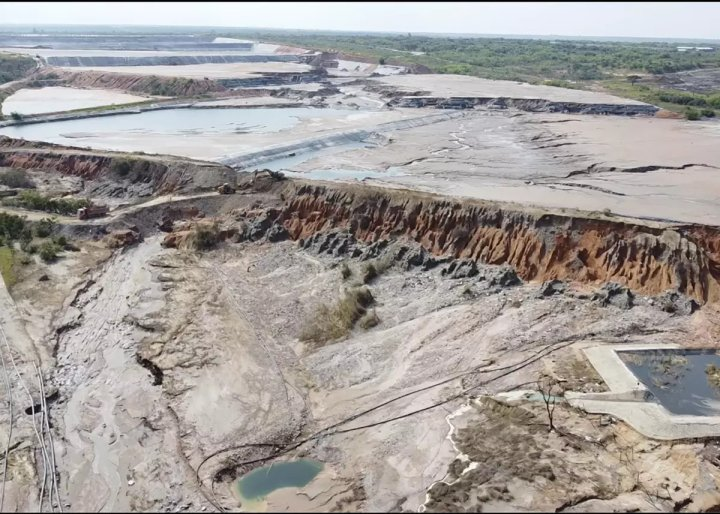
On February 18, 2025, the tailings dams of Sino-Metals Leach Zambia — a subsidiary of the Chinese state consortium China Nonferrous Metals Industry Group — collapsed in Chambishi district, Copperbelt province. Between 50 and 900 million liters of acidic waste loaded with heavy metals — cyanide, arsenic, copper, zinc, lead, chromium, cadmium — were discharged into the Mwambashi River, a direct tributary of the Kafue.
Sean Cornelius, a Chambishi resident, described it with a precision no technical report can surpass: “Before February 18, this was a living, vibrant river. The fish died and the birds disappeared almost immediately. Now everything is dead. It’s like a totally dead river. Incredible. Overnight, this river died.”
The Kafue is not just any river. It is the longest tributary of the Zambezi, the largest river flowing entirely within Zambia, and the water source for approximately 60% of the country’s population. The disaster directly affected more than 1.3 million people in the Kafue basin. And since this river flows into the Zambezi, which in turn flows into the Indian Ocean through Mozambique’s delta, it is likely that the disaster affected many more communities than are recorded. However, outlets such as Business & Human Rights and Human Rights Watch denounce that the Zambian government, led by President Hakainde Hichilema, greatly minimized the impact of the Sino-Metals spill. Hichilema came to power in 2021 as leader of the United Party for National Development, which defines itself as “liberal-democratic and ruralist” and has promoted thoroughly individualist ideals since its creation in 1998.
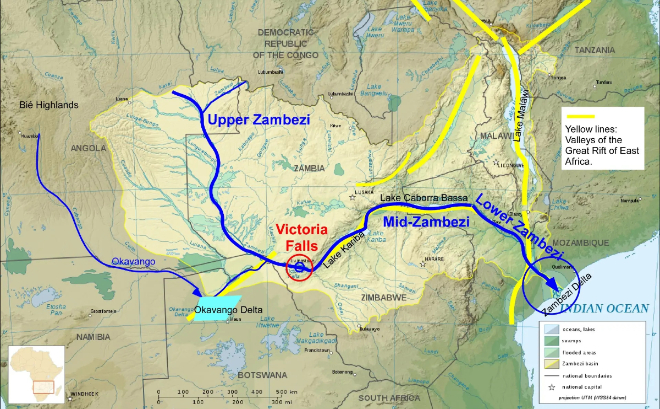
Signs of contamination were detected by independent investigations at least 100 kilometers downstream from the mine. Zambia’s Ministry of Water and Sanitation confirmed the destruction of crops along the riverbanks and expressed concern about contamination of groundwater. A dead hippopotamus, crocodiles, fish, and monitor lizards floating: the inventory of the catastrophe. Kitwe, the country’s second-largest city with 700,000 inhabitants, was left without drinking water. The Zambian Air Force had to drop lime from helicopters to try to neutralize the acidity.
The company’s lie and the government’s silence
What followed was no less revealing than the dam collapse. Sino-Metals initially admitted that only 50,000 tons of waste had been spilled. But in August 2025, the environmental consultancy Drizit — hired by the company itself to assess the damage — determined that the real figure was 1.5 million tons, with approximately 900,000 cubic meters of toxic waste still present in the environment. Sino-Metals’ response was to fire Drizit the day before it delivered its final report.
Six months after the disaster, the Zambian government declared the water “safe for consumption.” However, the U.S. and Finnish embassies ordered their citizens to evacuate the Copperbelt, citing contaminated water and even unhealthy air.
In July 2025, the government ordered Sino-Metals to pay provisional compensation to 454 farmers. Individual payments ranged from $17 to $2,000, amounts that victims described as insulting given the scale of their losses. To access those crumbs, Sino-Metals required the affected people to sign legal documents waiving their rights to future claims.
It’s not an accident. It’s a model.
It would be convenient for defenders of the Chinese model to present the Sino-Metals case as an isolated tragedy, a regrettable accident in an otherwise virtuous history of South-South cooperation. But the data does not support that reading.
Since the beginning of 2025, four mining companies — one British and three Chinese — have been accused of causing severe environmental damage in Zambia through the release of toxic waste into the Kafue basin. The second Chinese company involved, Rongxing Investments, faced accusations of acid spills and the death of a worker, which led to the arrest of its director. The third, Ozone Mine, was accused of discharging chemical waste that caused crop losses and waterborne diseases.
The pattern is replicated in Zimbabwe, currently governed by Emmerson Mnangagwa of the Zimbabwe African National Union–Patriotic Front. This party defines itself on its website as a “comprehensive movement of political, economic, and national liberation,” a pan-Africanist, populist party that has ruled Zimbabwe since independence in 1980.
With a consistency that hardly admits interpretation as error or exception, the actions of Chinese-owned mining companies are repeated in this country. Chinese companies control approximately 90% of Zimbabwe’s lithium reserves, a strategic mineral for electric battery production, of which China controls about two-thirds of global processing capacity. Several of these companies have been implicated in labor and human rights abuses, community displacement, and environmental damage including water and soil contamination and habitat destruction. Alexander Maphosa, vice-chair of the School Development Council of Mapeume Secondary School, told Zimbabwe Situation about working conditions in the mines: “They work without personal protective equipment, which causes serious injuries. It is not safe at all. They endure excessively long shifts: 16 hours a day. Our children are being degraded, just like our land.”
Farai Maguwu, founder and executive director of the Center for Natural Resource Governance, an organization based in Harare that seeks to defend, protect, and support communities affected by mining, told The East African: “At least 95% of these workers in Chinese mines work with temporary and fixed contracts, without healthcare, pensions, or any other necessary retirement benefits. Worse still, they are intimidated and victimized for participating in any union activity or joining unions, which makes it difficult for them to collectively negotiate better conditions.”
In Chiadzwa, Mutare district, Zimbabwe, where the Marange diamond fields are located, thousands of people were forcibly displaced to Arda Transau, Manicaland province, about 40 km away, to make way for diamond operations dominated by Chinese companies. More than a decade later, those communities still live in precarious housing without running water, adequate sanitation, or access to fertile land. Entire rivers such as the Save and Odzi in Manicaland have been poisoned by effluents from Chinese diamond and gold mines. In some cases, such as Heijin Mining in Murehwa in 2022, about 80 km from the capital Harare, companies ignored High Court orders suspending their operations.
In October 2025, villagers in Uzumba, Mashonaland East province, resisted plans by the Chinese company Hong Ri to set up a granite mining plant in the area, accusing the company of falsifying required environmental approvals. Representatives of the villages of Foto, Jenyura, and Magaya submitted a formal letter of objection to provincial authorities and two national ministries, warning that the operations would threaten the Chidye River, sacred cultural sites, and ancestral cemeteries.
Currently, the country is moving toward banning the export of lithium concentrate, recognizing its strategic value. This decision would significantly affect China due to its large stake in Zimbabwean mining. In parallel with this export restriction, the government is considering new partnerships in the sector with other countries such as the United States. This would not mean emancipation from an extractivist and colonial model with a perspective of caring for common goods, but simply changing executioners.
The Belt and Road: development or trap?
The Belt and Road Initiative (BRI), presented by Xi Jinping in 2013, is the grand ideological packaging of this expansion. The official narrative presents it as a project of infrastructure and connectivity for the development of the Global South, a counterweight to the conditionalities of the IMF and the World Bank.
This reading embellishes reality: in Africa, China has gained advantageous positions in many countries compared to the U.S. and European powers, while at the same time showing behaviors that have little to envy from traditional colonialism in terms of rapacity, disregard for environmental impacts, violation of human rights, and precarious working conditions.
The relationship generated by the BRI repeats dependency patterns, which are becoming increasingly pronounced. Africa is one of the places where China’s investment weight already surpasses that of other powers, and where it has most clearly deployed a level of usury reminiscent of the historical actions of European imperialist powers in the region.
The concrete mechanism is well known: China offers loans tied to the hiring of Chinese companies, in extractive sectors that export raw materials without local processing, under labor conditions that violate international standards, and with an environmental impact that local communities pay for with their health, their land, and their livelihoods. Many countries that initially viewed the BRI with enthusiasm, for the promise of development investments, are now reevaluating that enthusiasm.