As the leaders of the United States and China met in Beijing on Thursday, Xi Jinping had a much older rivalry on his mind.
The Chinese president invoked a warning from the Classical world, when the Greek city-states of Athens and Sparta went to war, saying that the United States and China should beware the “Thucydides Trap” in their own relations.
Xi cited the concept, popularized in recent decades, as he warned that Beijing and Washington could enter an “extremely dangerous place” if Donald Trump sought to impede China as it asserted itself over Taiwan.
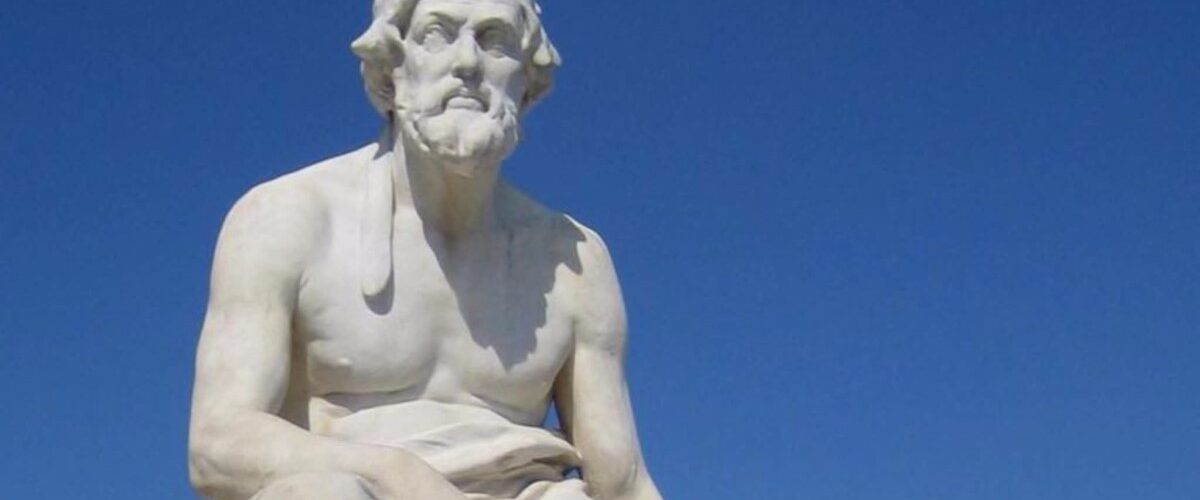
The trap referred to by Xi Jinping was named for Thucydides, the ancient Athenian general, whose account of the Second Peloponnesian War (431 B.C. to 404 B.C.) is considered one of the first written military histories.
In it, Thucydides argued that the war between Athens and Sparta was driven by the threat posed to an established power by one gaining strength. “The rise of Athens frightened Sparta and forced them into war,” wrote Thucydides. (The precise translation is contested among classicists).
For some scholars, the war — and the explanation offered for it in that ancient passage — presaged nearly every major conflict to follow. The international relations theorist Graham Allison dubbed it the “Thucydides Trap” in the early 2010s.
The idea is that when an established, great power is met with a rising power, conflict between the two is certainly likely if not inevitable.
In Xi’s version of the analogy, an emboldened China is the Athens to an American Sparta.
For more than a decade, Xi and top-ranking Chinese diplomats have invoked the concept, but presented it as a cautionary tale rather than an inevitability. “There is no such thing as the so-called Thucydides Trap in the world,” said Xi in 2015, before an audience that included the former secretary of state Henry Kissinger.
It was on his mind again at the meeting. Speaking before Trump in the Great Hall of the People, Xi said the world had reached a new crossroads. “Can China and the United States overcome the ‘Thucydides Trap’ and establish a new paradigm for relations between great powers?” he asked.
In reality, we are facing a reactionary rivalry between capitalist powers vying for the role of leading the exploitation of the global workforce. It is no surprise that Trump, following his defeat in Iran, arrived in Beijing in a weakened position, forced to listen to Xi speak about the dangers of a confrontation with China. A policy of class independence in the Asia-Pacific must be eminently anti-imperialist and anti-capitalist, rejecting both the aggressiveness of the United States and the imperial ambitions of China.