Unique characteristics of Korean capitalism and class struggle
The Korean War, from 1950 to 1953, destroyed the entire workers’ movement and all kinds of left movements, allowing the Korean capitalists to exploit and oppress the workers to a very high degree. From the 1950s to the 1970s, the United States provided South Korea with extraordinary economic and military aid in the context of the Cold War. These factors allowed Korean capitalism to take off as one of the so-called Four Asian Tigers in the 1970s and 1980s.
After the breakdown of the Cold War in the 1990s, Korean capitalism was forced to survive in the highly competitive world market without the previous patronage of the United States. Korean capitalism reformed its structure of exploitation with a neo-liberal ideology and a strategy of labor flexibilization, re-equipping itself with a highly competitive hyper-exploitation system, especially by making irregular workers its main labor force. Korean capitalism, as the geographically closest and technologically more developed economy to China, took advantage of the rise of the Chinese economy in the context of the US-China honeymoon of globalization.
As a result, Korean capitalism was able to experience several decades of consecutive growth despite some moments of crisis.
But the quantitative growth of Korean capitalism, based on highly intensive exploitation and oppression, was accompanied by the qualitative misery of Korean society. The rapid growth of Korean capitalism has brought a significant increase in the real wages of the working masses. However, the terrible neglect and repression of workers’ rights resulted in the longest working hours in the world, the highest rate of fatal occupational accidents, the highest proportion of irregular workers, and the widest gender wage gap.
Now, under the myth of economic growth from one of the poorest countries to a developed country in just a few decades, Korean society is experiencing the world’s worst suicide rate, the highest elderly poverty rate, and the lowest fertility rate. In particular, the world’s lowest fertility rate, which recorded only 0.72 in 2023, is so low as to seriously threaten the sustainability of society itself.
The notorious exploitation and oppression have made the Korean workers’ struggles highly militant and dynamic as a reflex. The great strike wave of 1987 and the general strike of 1996-97, which demonstrated the revolutionary potential of the Korean working class, attracted the attention of many workers and socialists around the world.
But the suppression of workers’ basic rights, such as the right to organize, bargain, and strike, through various bad labor laws, has kept the rate of unionization very low and made the workers who lead or even participate in the struggles face extreme adversity. The suppression of freedom of thought through the National Security Law has severely hindered the Korean working masses from having a working-class consciousness toward workers’ revolution or socialism.
As a result, the Korean workers’ movement has a unique characteristic, a structural imbalance between dynamic mass struggle and fragile class consciousness.
Bourgeois two-party system in South Korea
Similar to the United States, the political terrain of South Korea is largely occupied by the bourgeois two-party system. The conservative right-wing party, historically rooted in military dictatorships and now succeeded by the current ruling People Power Party, has blatantly represented the interests of the Korean capitalists and US imperialism. Meanwhile, the liberal center-right party, now succeeded by the main opposition Democratic Party, has used democratic rhetoric to win the support of the working people, but its regimes have also realized the interests of the Korean capitalists and US imperialism.
The liberal regimes have proven to be a more effective instrument for the Korean capitalists to introduce aggressive reforms without facing massive protests. For example, it was the liberal regime of the center-right party that introduced neo-liberal reforms and made irregular workers prevail in the late 1990s Asian Economic Crisis and later.
The former liberal regime, which came to power after the Candlelight Protests of 2016-17, promised a rapid increase in the minimum wage, but ended up raising the minimum wage less than the previous conservative regimes. The liberal regime said it would be a peace broker between the United States and North Korea, but continued to pursue a rapid military buildup of South Korea under a strong alliance with US imperialism.
Nevertheless, the liberal center-right party has repeatedly succeeded in recruiting a considerable number of famous activists from the student movement, the social movement, and even the trade union movement. Reformist parties have repeatedly formed electoral alliances with the liberal center-right party. These shameful and stupid things have seriously hindered the working masses from developing an independent working-class politics and again contributed to strengthening the bourgeois two-party system.
So, whenever the liberal regimes lost the support of the working people due to their anti-worker, anti-people, pro-capitalist, and pro-imperialist policies, the conservative right-wing party managed to come to power again, not the working class party.
Formation of the left in South Korea
The 1980 Gwangju Uprising was the real turning point in the modern history of South Korea. Hundreds of thousands of working people in Gwangju fought for a week against the military coup forces, formed a volunteer people’s army, and built an autonomous liberation order under siege before being crushed. The shock of the Gwangju Uprising made the most advanced part of the democratic student movement turn into a revolutionary democratic movement and then into a socialist movement.
However, the socialist movement at that time was heavily influenced by Stalinism and Maoism. And the more moderate majority became radical nationalists, supporting North Korea and pursuing reunification and national liberation without a clear answer to workers’ liberation.
The 1987 Great Workers’ Struggle, which was a great strike wave, was the starting point of the independent trade union movement as a mass movement. From July to September 1987, there were 3,341 strikes with 1.2 million participants. Almost all of them were illegal, and in most cases, the workers occupied their factories in a very militant way. As a result of the strike wave, about 1,000 new democratic unions were formed at the workplace level.
The socialist movement played an important role in the process of uniting democratic unions at the regional and national levels, overcoming the harsh repression of the military dictatorship, which finally led to the building of the Korean Confederation of Trade Unions (KCTU), the national center of democratic trade unions, in 1995.
But the collapse of the USSR in 1991 was a big blow to the socialist movement. Most of them abandoned the revolutionary perspective and became reformists or found their way into class-blind social movements. But the minority continued to struggle to find a way to build a revolutionary socialist movement with the help of Leon Trotsky and Rosa Luxemburg.
The 1996-97 General Strike against neoliberal labor reform unfolded for 24 days, with 150,000 to 350,000 participants each day. The general strike was much stronger than the number of participants because it covered the most important sectors of Korean capitalism. It didn’t achieve its goal, but it managed to change the relationship between classes to some extent.
The participation of hundreds of thousands of workers in the month-long general strike led to a massive consciousness of themselves as the working class. So the general strike paved the way for building an independent workers’ party. But the prevailing reformism forced the first independent workers’ party, the Democratic Labor Party, to be built as a reformist party in 2000.
Current reformist parties
The Democratic Labor Party was closed down in 2012 and split into a few reformist parties. Today, there are three reformist parties.
The first is the Justice Party. This party advocates Western-style social democracy. It has maintained about 5-6 seats but is now in crisis after losing popular support due to a series of opportunistic moves. The Party has walked a tightrope in its relationship with the Democratic Party. It has pursued a strategy in which it pretends to be an independent force but aligns itself with the Democratic Party at crucial moments to gain votes from center-right supporters.
However, when the right-wing president was elected in the last presidential election in 2022 by a margin of 0.7%, less than the 2.3% that the Justice Party candidate received, Democratic Party supporters believed that the right-wing president was elected because of the Justice Party, and there was a widespread sentiment among them that they would no longer vote for the Justice Party. The Justice Party, which won 9.7% of the vote in the 2020 general election, received only 2.1% of the vote in the recent general election in April and won no seats. The party’s strategy of trying to grow by hovering on the periphery of the Democratic Party finally ended in bankruptcy.
The second reformist party is the Progressive Party. This party is based on pro-North Korean radical nationalists. They pursue national liberation as their main cause, so they are commonly referred to as the NL. The NL tendency has formed the majority of the labor, peasant, and student movements since the 1980s. It currently controls the executive body of the Korean Confederation of Trade Unions (KCTU), the national center of democratic trade unions.
Compared to its organizational power, it had suffered from poor electoral results in bourgeois elections with 0 or 1 deputies. The party had wanted to form an electoral alliance with the Democratic Party but had been rebuffed because of its pro-North Korean image. This time, however, the Democratic Party paved the way for an electoral alliance, and the NL jumped on board. The Progressive Party formed a joint provisional party with the Democratic Party for the proportional representation election and unified candidates with the Democratic Party in all districts. As a result, the Progressive Party won one district seat and two proportional seats.
Meanwhile, regarding the North Korean leader’s declaration in the last December that he would no longer promote the peaceful reunification of the Korean Peninsula, the NL tendency looks embarrassed and confused about how to interpret and respond to it, but simply follows it.
The third reformist party is the Labor Party. Roughly speaking, this party follows the neo-reformist line like Syriza or Podemos. This party is much smaller than the other two and has no seats. The party opposed the coalition with the Democratic Party, but it had little impact on the election.
Last year, the Korean Confederation of Trade Unions (KCTU), the national center of the democratic trade union movement, adopted a new political policy to make workers a political force for the first time in more than a decade. In the new political policy, the KCTU strongly criticized the fact that many former and current union cadres had become Democratic Party candidates or supported the Democratic Party, and explicitly prohibited similar moves.
This year, however, the NL, which has taken control of the KCTU executive, attempted to pass the KCTU’s official endorsement of the Progressive Party’s electoral alliance with the Democratic Party. A vigorous campaign by delegates and rank-and-file activists against the endorsement unfolded, and the KCTU delegate conference on March 18 ended without a clear conclusion. Although many delegates and rank-and-file activists opposed the electoral coalition with the Democratic Party, they could not see any real alternative for independent working-class politics.
The revolutionary socialists were unable to field candidates in this election because of their organizational weakness. While it is clear that bourgeois elections cannot change the world, it is also clear that revolutionary socialists have a responsibility to present the prospect of independent working-class politics as an alternative to the working masses and people, even in the space of bourgeois elections.
Only through an independent working-class party with a revolutionary perspective and strategy will the working masses and people of South Korea be able to break free from the chains of the bourgeois two-party system and begin to move forward toward real hope. Revolutionary socialists are called upon to take up the urgent challenge of bridging the gap between the tasks of reality and their own capacities.
Apart from these three reformist parties, there are some small Stalinist and Maoist groups.
What the revolutionary socialists are fighting for in South Korea
March to Socialism was officially founded in October 2022. It is really new. However, it is based on the long tradition of revolutionary socialist activities and the continuous efforts to unite important small revolutionary groups under a unified program and discipline.
There are some other revolutionary socialist groups in South Korea. Among those revolutionary socialist groups, March to Socialism has the biggest influence on the workers’ movement, the women’s movement, and the climate movement.
Currently, March to Socialism is focusing on four tasks.
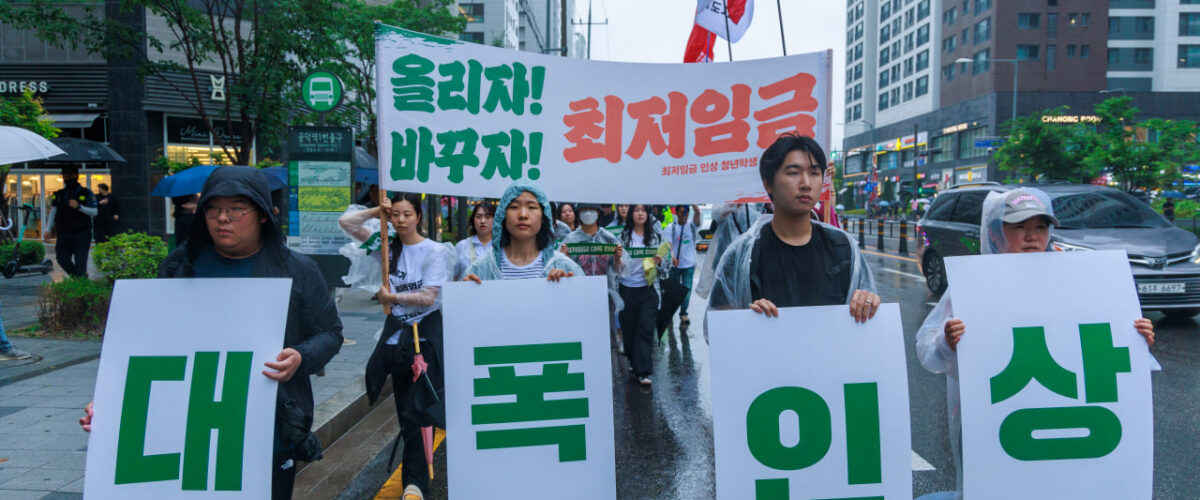
First: to build a general strike for the urgent demands of the workers
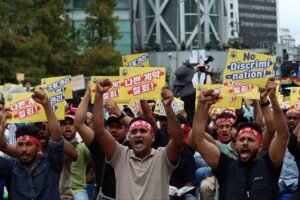
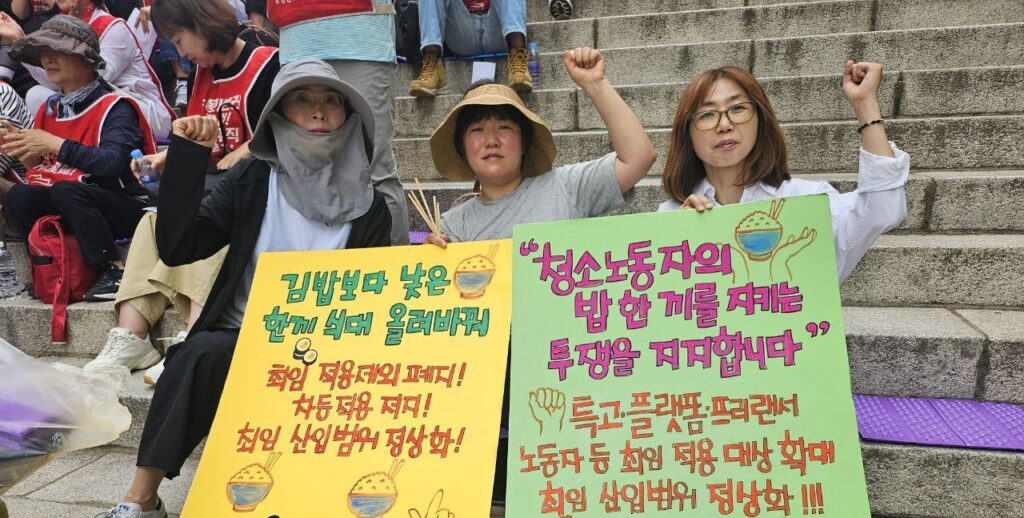
There are big disparities in wages and working conditions between regular workers in large companies and irregular workers in small companies. In 2023, irregular workers received only 54% of the wages of regular workers. This is related to the fact that 46.3% of regular workers in large companies with more than 300 employees are organized, but only 0.2% of irregular workers in small companies with less than 30 employees are organized.
Since 1987, more precisely since the late 1990s, organized regular workers have defended and even improved their wages and working conditions. However, unorganized, irregular workers have continuously lost wages and working conditions. In addition, the Labor Code has forced irregular workers to suffer great difficulties in their unionizing and striking.
These disparities have affected the whole terrain of class struggle. Most irregular workers consider these disparities more serious than the much wider gap between the capitalists and the working class, because regular workers are closer to them. Taking advantage of this feeling among irregular workers, the bourgeois parties have successfully isolated the democratic trade union movement, the most important social force not only for workers’ rights but also for social progress in South Korea.
Therefore, the struggle for the unorganized irregular workers, especially for the increase of the minimum wage and the right to unionize and strike for the irregular workers, is the most urgent task of the democratic trade union movement, the KCTU. However, the KCTU has not committed itself to such an urgent task because most of its affiliates have immersed themselves in narrow trade unionism focused on their own union members through serious bureaucratization.
Under these circumstances, March to Socialism has steadily insisted on building a general strike for the urgent demands of the workers, especially for the minimum wage increase and the right to unionize and strike for irregular workers. Such a general strike would be a powerful blow to the present right-wing government and another important turning point for great progress in the history of the Korean workers’ movement.
On March 18, at the KCTU delegate conference, a resolution was proposed by a supporter of March to Socialism to build a KCTU general strike for the minimum wage increase and the right to unionize and strike for irregular workers in June 2024. The resolution received 315 votes out of 1002, so it did not pass. However, the fact that about 30 percent of the KCTU delegates supported the resolution showed that the possibility of building such a general strike in the near future is not impossible.
Second: to build a women’s strike for the rights and liberation of women and LGBTQ+
Under capitalism, social oppression and discrimination against women and LGBTQ+ people are continuously reproduced and expanded by the capitalist class to intensify exploitation. Women workers and LGBTQ+ workers suffer the most from such oppression and discrimination.
In particular, South Korea has the widest gender pay gap in the OECD, at 31.2% in 2022, much higher than the OECD average of 12.1%. The irregular female workers received only 38.8% of the wages of the regular male workers. The fact that career interruptions due to pregnancy, childbirth, and childcare force most women to become irregular workers is one of the main causes of the widest gender pay gap. This low-income and unstable employment of irregular women workers has largely affected the lowest fertility rate in the world. According to recent data, the fertility rate of underemployed irregular workers has been only a quarter of that of regular workers in large companies for the past 14 years.
The liberation of women and LGBTQ+ people from social oppression and discrimination can only be realized through the abolition of capitalism. Conversely, the working class can only grow into a social force capable of abolishing capitalism if it unites the struggle against exploitation with the struggle against social oppression and discrimination. The wave of women’s strikes that has swept many countries in the last decade, including Poland, Switzerland, Iceland, Ireland, Spain, and Argentina, has shown an important possibility for realizing this direction.
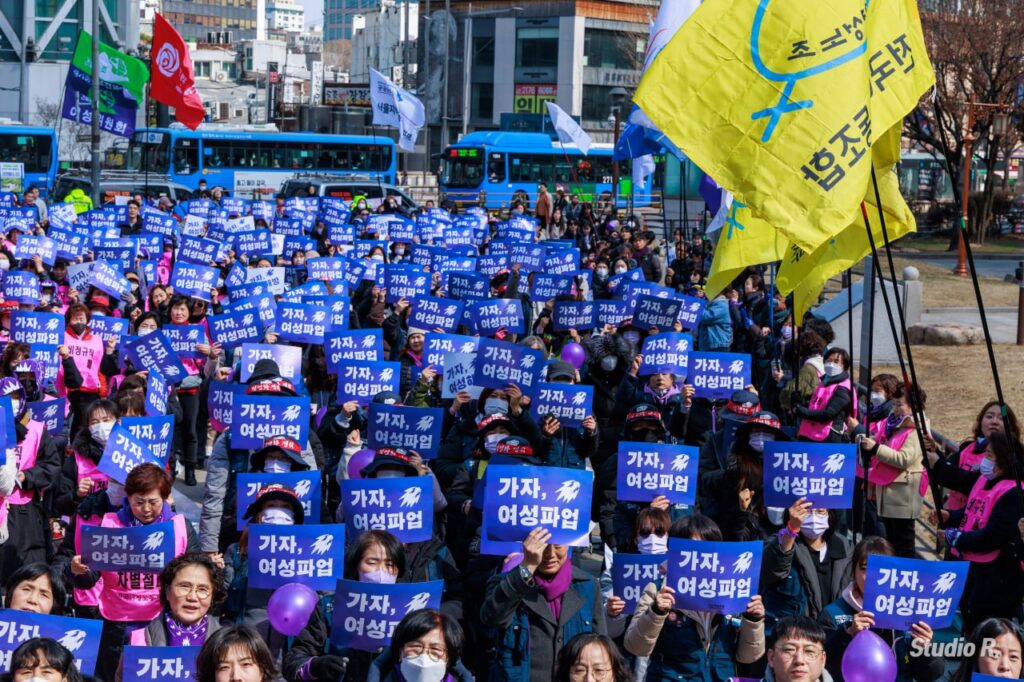
In South Korea, where the women’s movement has been largely dominated by liberal feminism and separatist feminism, March to Socialism has proposed working-class feminism and the women’s strike as an alternative. On March 8 of this year, there was the first women’s strike in South Korea. Of course, it was very small with only 800 participants. However, two unions organized a real strike, and many women workers stopped work to join the rally. 41 organizations, including women-centered unions, feminist groups, LGBTQ+ groups, student organizations, and various social movement groups, also participated in the rally.
The women’s strike raised five demands, such as closing the gender pay gap, making care more public, ensuring labor rights for all, including job security and the elimination of irregular work, introducing health insurance coverage and miscarriage induction for pregnancy termination, and raising the minimum wage.
March to Socialism will continuously try to develop women’s strikes, especially by organizing the KCTU as the main force of the women’s strike.
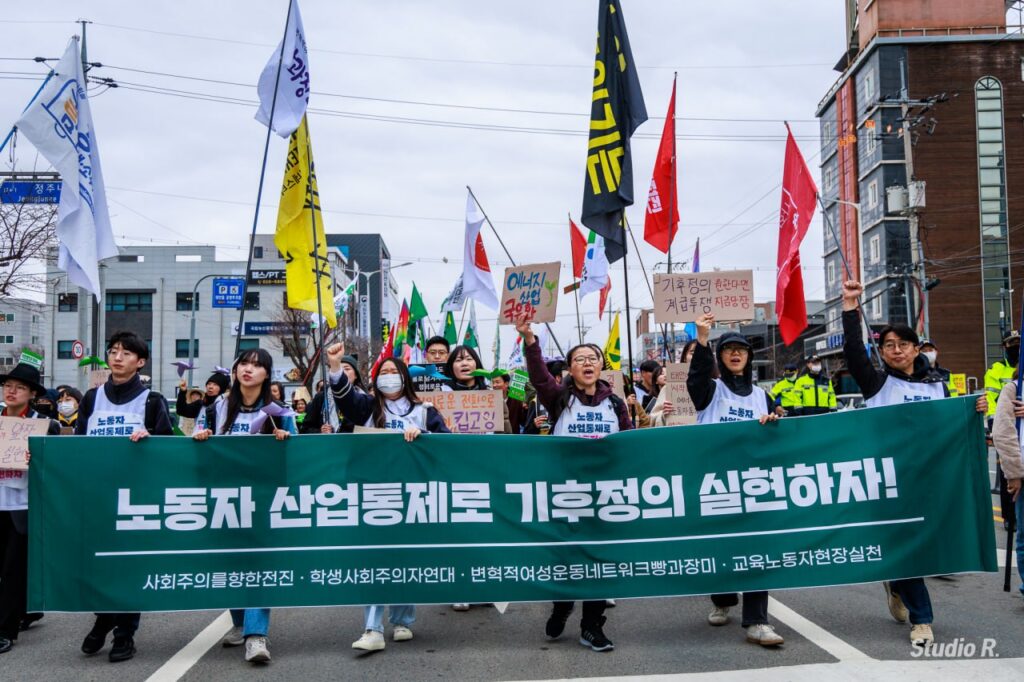
Third: to build a worker-led climate justice movement
Capitalism, which is blindly immersed in the expanded reproduction of capital for profit alone, is the main culprit of the climate crisis. Therefore, it is very clear that the capitalist class and capitalist governments cannot solve the climate crisis.
Now, almost all corporations are becoming pro-environment with disgusting greenwashing. Some bourgeois politicians and reformists are pushing the Green New Deal, selling the false hope of a combination of overcoming the climate crisis and reviving capitalism. The class-blind environmental movement leads us to ethical consumerism, hiding the real culprits of environmental destruction. Taking advantage of the confusion created by these misdirections, right-wing capitalist forces are blatantly trying to inflict a strong backlash on the climate movement.
Nevertheless, the planet continues to send warning signs. 2023 was the hottest year on record, 1.45 degrees Celsius above pre-industrial levels. We are on the verge of the 1.5-degree Celsius threshold.
Capitalism cannot solve the climate crisis. So the working class, whose interests are at stake in the abolition of capitalism, must take the lead in solving the climate crisis. The industrial transformation and reorganization to the green that guarantees the rights of workers and people must be carried out as quickly as possible under workers’ control at the international level.
The Korean government, which should rightly be called one of the worst climate villains, has closed 6 out of 58 coal-fired power plants and has a plan to close another 22 plants by 2036, insisting on the construction of 7 new coal plants. Previous coal plant closures have resulted in the unemployment of irregular workers and the disruption of communities. About 8,000 workers will lose their jobs due to coal plant closures.
Under these circumstances, by the end of 2022, regular and irregular workers in one coal plant formed the Tae-an Coal Plant Workers’ Collective for a Just Energy Transition, led by a member of March to Socialism. The collective covers six regular and irregular unions with a total of 700 workers. About 50 workers regularly participate in meetings, discussions, and campaigns. They demand the nationalization of the energy industry under workers’ control, and try to integrate workers’ employment, community sustainability, and overcoming the climate crisis into one. The collective has attracted a lot of interest from the broader climate movement.
On March 30, a national climate rally and march was held in their region, Tae-an, with a thousand workers and climate activists gathering. And on May 28 and 29, an irregular workers’ union with 270 members at another coal plant organized a strike, demanding the closure of coal plants to overcome the climate crisis and a just transition to secure workers’ jobs and rights.
In the bus industry, a member of March to Socialism has organized his union around the demand for “full public ownership of public transport to achieve free public transport to overcome the climate crisis”.
Of course, these are only the first steps. But March to Socialism is trying to find a way forward for a worker-led climate justice movement.
Fourth: to build international anti-imperialist/anti-war struggles of the working class
Globalization, which has shifted the capitalist production base from developed countries to emerging countries, has changed the power relations among the capitalist states. On top of this, with the deepening of the capitalist crisis, the desire of the old and new imperialist powers for geographical expansion for more super-exploitation and expropriation has intensified. This has inevitably intensified the imperialist hegemonic confrontation, especially between the USA and China.
In this context, the war in Ukraine has been going on for more than two years as a proxy war between the US-NATO alliance and the China-Russia alliance. Israel, which is fundamentally supported by the US-EU imperialist powers, is committing genocide in Gaza and provoking a wider war across the Middle East.
We cannot say where, when, or how big the next war will be. We cannot say how many wars will break out. But what is clear is that the world is now moving toward serious wars between the imperialist powers, perhaps proxy wars rather than direct wars because of the formidable nuclear arsenals. Of course, there are many obstacles and contradictions on the way to serious wars. But the trend is clear.
In particular, East Asia could be the main battlefield. Taiwan has become the sharpest flashpoint in the hegemonic confrontation between the US and China. The confrontation between the US-Japan-South Korea alliance and the China-Russia-North Korea alliance has been formed around the Korean Peninsula, exchanging harsh rhetoric, large-scale war games, and constant missile launches.
Under these circumstances, the only solution to block the war should be massive anti-imperialist/anti-war struggles of the working class armed with international solidarity, such as international anti-imperialist/anti-war general strikes. To build such struggles, March to Socialism is organizing its activities in two directions.
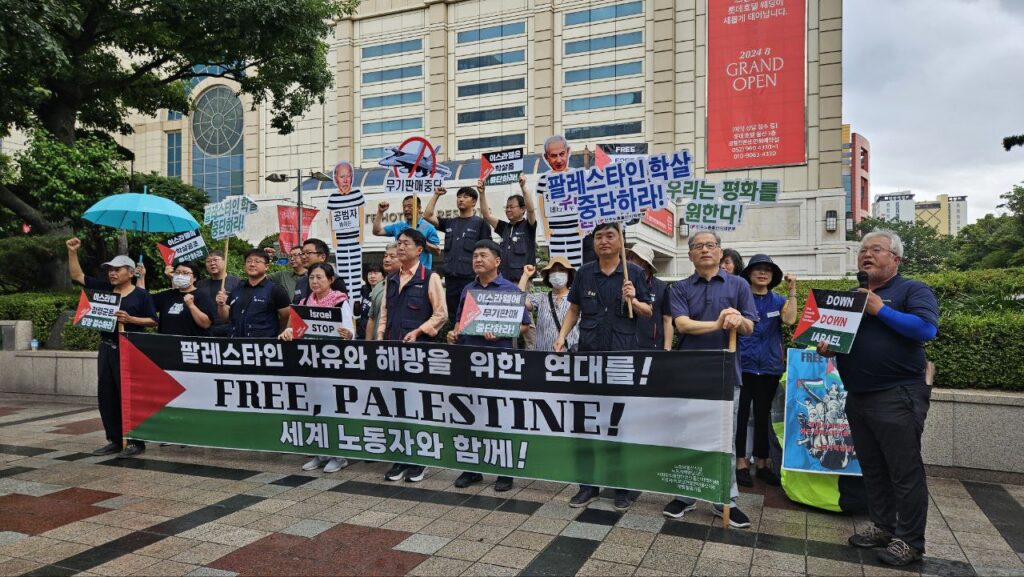
First, it is trying to build an anti-imperialist/anti-war workers’ movement in South Korea. Recently, it has jointly organized many campaigns in support of the liberation of Palestine, demanding an immediate ceasefire and an end to the genocide in Gaza. It is fighting against the Korean government’s export of weapons to Israel and against Hyundai Construction Equipment’s export of excavators to Israel.
Above all, March to Socialism is committed to organizing workers into these campaigns, even though the numbers are still relatively small. It will try to develop these struggles into anti-imperialist/anti-war struggles against both the US-Japan-South Korea alliance and the China-Russia-North Korea alliance around the Korean Peninsula, by organizing more and more workers based on internationalism, not nationalism.
Second, March to Socialism is trying to meet with socialists in other countries in East Asia to discuss the necessity of joint efforts to build massive international anti-imperialist/anti-war struggles of the working class and find where to start.