The recent general election in South Korea on April 10 dealt a decisive blow to the incumbent right-wing president, Yoon Suk-yeol. The liberal center-right opposition forces, centered in the Democratic Party, won a resounding victory, taking 62% of the seats. But the ruling conservative right-wing People Power Party obtained only 36% of the seats, barely passing the one-third threshold. If it had failed to pass the one-third threshold, it would not be able to prevent the opposition from neutralizing the president’s veto power, impeaching the president, and passing a constitutional amendment.
The distribution of seats in this election almost mirrors the president’s approval ratings, which have been stuck at 35% approval and 60% disapproval since three months after the current president took office in May 2022. The right-wing president has pursued blatantly pro-capitalist policies in various aspects including tax policy, real estate regulation, labor policy, etc. He has also pursued hardline pro-US and pro-Japanese policies that have led to increased tensions on the Korean Peninsula. Deteriorating relations with China have accelerated the decline in economic growth, and persistent inflation has added to the suffering of the people. He won the presidential election on a platform of “fairness and common sense,” criticizing the hypocrisy of center-right politicians, but as president he has obstructed investigations into his own and his spouse’s alleged crimes.
Thus, this general election was widely expected to be a harsh judgment on the right-wing president by the working masses and people, and it turned out as expected.
However, the reckoning of the right-wing president was carried out in such a way that the working masses and people were once again thoroughly trapped in the bourgeois two-party system. In this election, the reckoning of the right-wing president came in the form of support for the center-right opposition candidates. Just two years earlier, the reckoning of the center-right regime came in the form of support for the right-wing presidential candidate.
The working masses and people have been trapped in a bourgeois two-party system that spins an endless wheel. The right and the center-right have alternated in power repeatedly, but nothing has really changed. The center-right just pursues pro-capitalist policies in a more refined way. It also has to pursue pro-US and pro-Japanese policies because it is also strictly subordinated to US imperialism and the US is strongly pushing the US-Japan-South Korea alliance over the Korean Peninsula against the China-Russia-North Korea alliance in the context of increased hegemonic confrontation with China. There is no difference between the center-right and the right-wing in trampling on fairness and common sense to protect their privileges.
Once again, the working masses and people were defeated because they were once again trapped in the deceptive political structure of the bourgeois two-party system.
Under these circumstances, the reliance of the reformist parties on the center-right forces has contributed to the continuation of the bourgeois two-party system.
The social-democratic Justice Party, which previously held six seats, did not win a single seat this time. The Justice Party has walked a tightrope in its relationship with the Democratic Party. It has pursued a strategy in which it pretends as an independent force but aligns itself with the Democratic Party at crucial moments to gain votes from center-right supporters.
However, when the right-wing president was elected in the last presidential election by a margin of 0.7%, less than the 2.3% that the Justice Party candidate received, Democratic Party supporters believed that the right-wing president was elected because of the Justice Party, and there was a widespread sentiment among them that they would no longer vote for the Justice Party. The Justice Party, which won 9.7% of the vote in the 2020 general election, received only 2.1% of the vote in this election and won no seats. The party’s strategy of trying to grow by hovering on the periphery of the Democratic Party finally ended in bankruptcy.
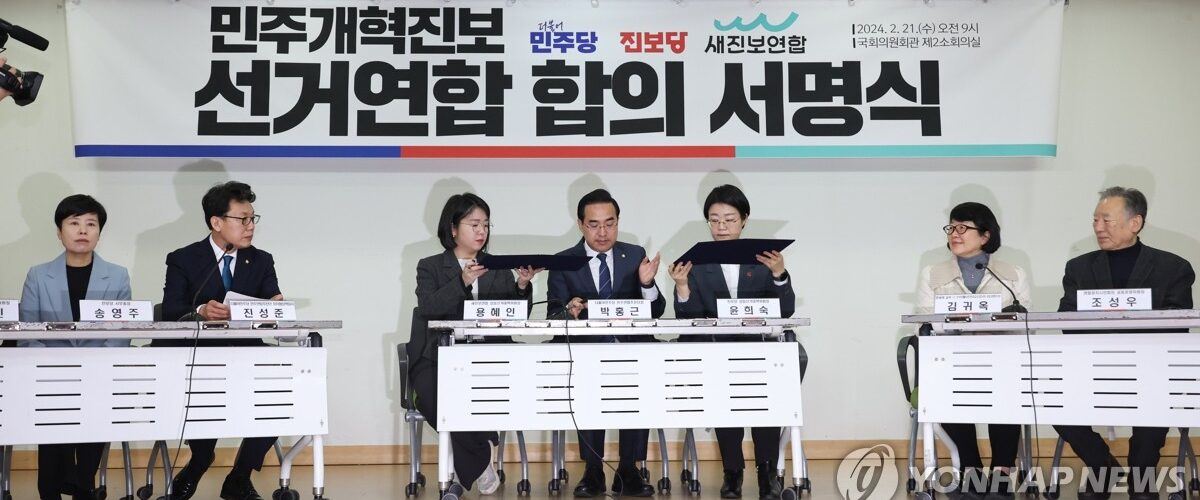
On the other hand, the radical nationalist Progressive Party, the so-called National Liberation (NL) tendency, had wanted to form an electoral alliance with the Democratic Party but had been rebuffed because of its pro-North Korean image. This time, however, the Democratic Party paved the way for an electoral alliance and the NL jumped on board. The Progressive Party formed a joint provisional party with the Democratic Party for the proportional representation election and unified candidates with the Democratic Party in all districts. As a result, the Progressive Party won one district seat and two proportional seats.
The Labor Party, the smallest of the reformist parties, opposed the coalition with the Democratic Party, but it had little impact on the election, fielding only a handful of candidates, one for district and two for proportional representation, who received few votes.
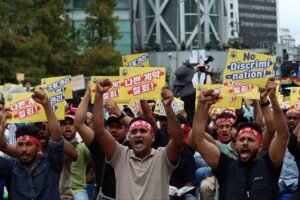
Last year, the Korean Confederation of Trade Unions (KCTU), the national center of the democratic trade union movement, adopted a new political policy to make workers a political force for the first time in more than a decade. In the new political policy, the KCTU strongly criticized the fact that many former and current union cadres had become Democratic Party candidates or supported the Democratic Party, and explicitly prohibited similar moves.
This year, however, the NL, which has taken control of the KCTU executive, attempted to pass the KCTU’s official endorsement of the Progressive Party’s electoral alliance with the Democratic Party. A vigorous campaign by delegates and rank-and-file activists against the endorsement unfolded, and the KCTU delegate conference on March 18 ended without a clear conclusion.
Although many delegates and rank-and-file activists opposed the electoral coalition with the Democratic Party, they could not see any real alternative for independent working-class politics. The revolutionary socialists were unable to field candidates in this election because of their organizational weakness. While it is clear that bourgeois elections cannot change the world, it is also clear that revolutionary socialists have a responsibility to present the prospect of independent working-class politics as an alternative to the working masses and people even in the space of bourgeois elections.
Only through an independent working-class party with a revolutionary perspective and strategy will the working masses and people of South Korea be able to break free from the chains of the bourgeois two-party system and begin to move forward toward real hope. Revolutionary socialists are called upon to take up the urgent challenge of bridging the gap between the tasks of reality and their own capacities. To this end, the March to Socialism is trying to build the independent political power of the working class by organizing crucial activities, including the campaign for a general strike for the urgent demands of irregular workers, such as raising the minimum wage and guaranteeing the right to organize and strike, the women’s strike for the rights and liberation of women and LGBTQ+, the worker-led climate justice movement in the face of the climate crisis, and the anti-imperialist/anti-war movement that begins with solidarity for the Palestinian liberation and moves on to the struggle against the confrontation and war drive of the US-Japan-South Korea versus the China-Russia-North Korea alliances over the Korean Peninsula.