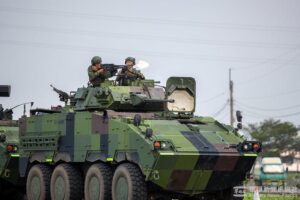
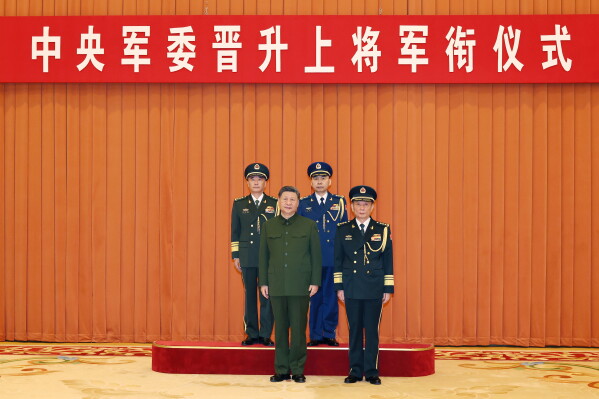
The PLA celebrated its 99th anniversary on Saturday, entering the final countdown to its centenary modernisation goal. A couple dozen generals were missing from the picture – alas, they were targeted by Xi Jinping’s anti-corruption campaign in the top brass for the last few years. In fact, it is still going: Beijing just removed 9 PLA generals from the top legislature this month, mostly from the strategic PLA Rocket Force (charged with nuclear weapons).
Now, this sweeping anti-corruption drive in China’s military appears to have cleared the way for a new batch of officers to quietly assume de facto leadership of key People’s Liberation Army bodies. New faces have been steadily filling gaps in the chain of command over recent months, including at the official reception to the PLA’s celebration on August 1, date of the founding of the PLA during the 1927 Nanchang uprising.
The latest major military upheaval in China came in January 2026, when authorities announced that CMC vice-chairman Zhang Youxia and fellow member Liu Zhenli were under investigation. It was not just another episode in the routine of the Chinese Communist Party’s anti-corruption campaign, as we said here. It highlighted growing doubts about China’s preparedness for a high-intensity war, the difficulty of mobilizing a population hit hard by economic struggles, and the Bonapartist turn that both major superpowers — China and the United States — are undergoing.
The outcome of that military makeover is now coming to light. And it represents a major structural shift across key People’s Liberation Army (PLA) bodies—including Central Military Commission (CMC) departments, theater commands, and technical service arms. In particular, the logic of the promotion process seems to have changed tack: newly ascendant officers are not as close personally to Xi Jinping as previous ones – even if the loyalty credential remains of topmost importance.
New Faces
Names like Zhang Shuguang (named secretary of the CMC’s discipline inspection commission), Cai Zhijun (new leader of the PLA Ground Force), and Wang Gang (confirmed as commander of the PLA Air Force) are now spoken of as the new strata of Generals in charge of military command within the PLA.
Almost none of these officers served in senior procurement roles within the Equipment Development Department or legacy Rocket Force logistics, all mired in the latest purges. Many were elevated directly from deputy or chief-of-staff roles rather than lateral transfers from rival factions.
This new quiet process of selection by the top government has an interesting caveat to it. The names chosen are not part of Xi Jinping’s traditional personal inner circle.
Earlier in his tenure, Xi relied heavily on generals with whom he had direct personal history—such as the “Fujian Faction” (officers he knew during his tenure in Fujian province, like He Weidong and Miao Hua) or the “Shaanxi Gang” / princeling connections (such as Zhang Youxia). However, after sweeping anti-corruption purges swept through the military’s senior ranks, Xi targeted even those historical loyalists.
By a sort of a “learning curve”, the new set of officers stepping into key roles of military leadership are not close to the Party’s top mandarin, or of his previous governing experiences in China’s provinces up until 2012. Loyalty credentials are key; but they look to be combined with familiarity to battle skills and combat preparedness.
Not surprisingly, officers in this new cohort generally lack independent political bases, high-profile public standing, or long-standing informal networks (guanxi) within the military apparatus. Because their promotion is entirely dependent on the top leadership rather than personal patronage networks, they present a low threat of forming rival cliques or challenging the CMC Chairman Responsibility System.
They also seem to balance strict political discipline with modern operational focus—especially in aerospace, cyber, and air operations. In other words, people focused on combat operations, one of China’s major weaknesses.
State media footage showed the new officers seated in the front rows usually reserved for senior military leaders. Officers with air force backgrounds appeared to have made the most gains. According to a South China Morning Post tally, nine of the 20 key positions reassigned during the reshuffle went to air force officers (PLAAF). For instance, Air Force Lieutenant General Chen Demin and Vice-Admiral Xiong Zhaoyuan appear to have taken charge of the commission’s Political Work Department, responsible with ideological issues within the military – that is, respect and benevolence towards Xi. The department’s former director, CMC member and former admiral Miao Hua, was placed under investigation in November 2024.
But who are they? Take for example General Zhang Shuguang. A veteran PLA anti-graft officer whose entire career trajectory was built inside internal oversight systems. He previously directed the CMC’s Discipline Inspection Bureau and served as discipline chief for the Northern Theater Command Air Force and the PLA Ground Force. As successor to CMC Vice Chairman Zhang Shengmin in running the military’s top internal enforcement network, he represents the institutional mechanism tasked with politically vetting and purging corrupt cadres.
Besides that, Zhu has advocated for transforming the Marine Corps into an expeditionary, multi-domain force capable of contested logistics, seizing strategic island chokepoints, and integrating advanced cyber, electronic warfare, and unmanned systems into maritime assault operations. All to Xi’s premium view of an aggressive naval power.
Another example is Lieutenant General Dong Li. Dong also belongs to a cohort of senior PLA Air Force officers being elevated into core joint command structures. Modern PLA doctrine places air defense integration, multi-domain battlefield awareness, and precision joint strikes at the center of modern warfare – all traits espoused by Dong. His background in flight testing and theater-level air staff operations emphasizes practical combat readiness, airspace management, and real-time command execution.
Like other recent elevations to top CMC bodies, Dong’s career track was rooted in operational units and command staffs rather than the logistics and equipment procurement networks targeted in major anti-corruption sweeps. Same thing as General Wang Gang. A former aerobatic pilot and longtime aviator who worked his way up through flight operations, he eventually became Director of the PLA Air Force Military Training Department and PLAAF Chief of Staff. His operational background contrasts with officers who spent careers in equipment acquisition offices.
Martial centered choices, unresolved problems
This appears to be a key feature to the new promotions. A central driver of recent PLA purges was systemic corruption within equipment procurement networks, logistics departments, and the PLA Rocket Force. This new cohort was deliberately selected from operational backgrounds—such as flight testing, theater air/maritime staff, and internal discipline inspection—where they had little to no exposure to defense acquisition budgets.
Rather than “political generals” who built careers managing patronage, officers like Dong Li and Zhu Chuansheng (Marine Corps amphibious tactics) are operational specialists. Xi Jinping needs commanders capable of executing complex joint-force operations, real-time C4ISR data sharing, and multi-domain warfare to meet PLA modernization deadlines.
The evolution of Xi’s personnel selection demonstrates a move away from relying on personal cronies to enforcing strict systemic compliance. By appointing lower-profile, highly disciplined technocrats, Xi reinforces the principle that the military’s loyalty belongs to the Party leadership and the CMC Chairman position itself, rather than to individual general officers.
More than that Xi needs people familiar with military tactics and combat operations, which he is sorely lacking. For example, Generals Han Shengyan and Yang Zhibin are Operational officers recently elevated to stabilize the vital front-line commands facing Taiwan (Eastern Theater) and the capital area (Central Theater). Their focus centers on maintaining joint-exercise battle readiness while filling executive voids left by outgoing senior command staff.
The problem is: there are no signs that any newly appointed general in the PLA can muster enough battle-hardened experience to improve the cronic crisis within the political regime. To be worried about enhancing military skills dos not equal combat readiness. The preparedness can be more at stake with officers who cannot count with the experience previous members had. So, time is still a precious input. Nothing will be solved overnight.
Therefore, the new cohort does not represent a choice of combat expertise over political loyalty. But it certainly reflects Xi’s urgent requirement for technically competent executioners who carry zero corruption risk and present no threat to centralized political control. In light of American imperialism advancing wars in the Middle East, with Iran, China’s capitalist state feels the need to not just rearrange loyalties but to increase its combat capacity, as of now unproven in the battlefield.
The reshuffle is a test and will take time to show signs of improvement; the last military crisis showed deep fractures in the relationship between the political government and the PLA. More than anything else, the move shows that Xi Jinping’s China is employing its time not only in elevating the country’s technological prowess, but also announcing to the world the increasing martial character of its capitalist ambitions – certainly not to the benefit of workers neither in China, nor worldwide.